

Essential director responsibilities for South African SMEs
Executive Summary
- South African SME directors have clear statutory duties under the Companies Act, including acting in good faith and avoiding conflicts.
- Personal liability for directors arises from reckless trading, tax debts, or unauthorized decisions causing losses.
- Practical governance involves customizing MOI, maintaining D&O insurance, documenting decisions, and regular compliance reviews.
Most South African SME owners wear many hats: founder, salesperson, operations manager, and director. That last title carries legal weight that surprises many people. Directors face serious liability under Section 77 of the Companies Act 71 of 2008 and can be banned for gross negligence, regardless of company size. This is not a big-corporate problem. A director of a ten-person business faces the same statutory obligations as one sitting on a JSE-listed board. This guide breaks down what those duties actually are, where the real legal risks live, and how to build practical governance habits that protect both your business and your personal assets.
Table of Contents
- Understanding statutory director duties in South Africa
- Personal liability and legal risks for directors
- Business judgement rule: Protecting director decisions
- Practical governance tools and expert insights for SMEs
- What most SME founders miss about director responsibilities
- Get expert help with director duties and compliance
- Frequently asked questions
Key Takeaways
| Point | Details |
|---|---|
| Statutory duties matter | Directors must understand fiduciary and care obligations or risk personal liability. |
| Liability can be personal | Directors in South Africa may face bans or legal claims for reckless or negligent conduct. |
| Business judgement rule protects | Properly documented decisions, free from conflicts, reduce directors’ liability risk. |
| Practical tools for compliance | Tailored MOIs, director agreements, and insurance can keep SME directors compliant. |
| Ethical culture is key | Building governance habits, not just ticking boxes, supports sustainable SME growth. |
Understanding statutory director duties in South Africa
The Companies Act 71 of 2008 codified director duties in sections 75 to 78, ending any ambiguity about what is expected. Before this, duties were scattered across common law and case precedent. Now they are clear, enforceable, and apply to every director regardless of whether they are executive or non-executive.
Section 76 mandates broad fiduciary, care, and skill standards for every director. A fiduciary duty means you must act in good faith, place the company’s interests above your own, and avoid situations where personal benefit conflicts with your duties. These are not aspirational standards; breaching them creates direct legal exposure.
The duty of care, skill, and diligence uses a dual standard. It asks both what a reasonably diligent person would do in your position (objective) and what someone with your specific knowledge and experience should know (subjective). If you have a finance background and sign off on fraudulent accounts claiming ignorance, the subjective standard will not protect you.
Core statutory duties at a glance:
- Act in good faith and in the best interests of the company
- Avoid conflicts of interest, and disclose any personal financial interest
- Exercise the level of care and skill appropriate to your role
- Not use company information or position for personal advantage
- Participate actively and attend board meetings
| Duty type | Source | Who it applies to |
|---|---|---|
| Fiduciary duty | Section 76(2) | All directors |
| Duty of care and skill | Section 76(3) | All directors |
| Conflict disclosure | Section 75 | All directors |
| Liability for losses | Section 77 | All directors |
When setting director agreements early in a company’s life, these statutory benchmarks should form the baseline of every agreement. Equally, if you are still at the stage of company registration steps, understanding these duties before you accept appointment is far better than learning them in a courtroom.
Pro Tip: Have every incoming director sign a written acknowledgement that they have read and understood their statutory duties. It takes ten minutes and creates a paper trail that matters if a dispute arises later.
Personal liability and legal risks for directors
Understanding your duties is one thing. Grasping what happens when those duties are breached is another conversation entirely, and one that most SME directors avoid until it is too late.
Section 77 sets out the specific grounds for personal liability. Directors face personal liability for reckless trading, misleading actions, or unauthorised decisions that cause loss to the company or its creditors. Liability can be joint and several, meaning creditors can pursue any one director for the full amount of a loss, not just their proportional share.

Reckless trading is the most common trigger for SMEs. It occurs when a director continues operating a business knowing it cannot pay its debts, or when they take on obligations without a reasonable belief that the company can meet them. This is not restricted to deliberate fraud; negligent optimism qualifies.
Tax exposure is a separate and serious risk. SARS liability for PAYE and VAT can attach to directors personally, delinquency bans can last five years or more, and certain reckless trading claims carry no prescription period. That means there is no time limit on pursuing you.
Common triggers for director liability in South African SMEs:
- Trading while insolvent or near-insolvent
- Failing to submit PAYE or VAT and allowing tax debt to accumulate
- Signing financial statements that misrepresent the company’s position
- Authorising payments to related parties without board approval
- Ignoring auditor or accountant warnings about financial distress
“A director who allows a company to trade recklessly, even without fraudulent intent, can be held personally liable for every rand of loss caused during that period.”
The question of choosing business structure matters here too. Some structures offer more liability protection than others, and the way a company is governed internally affects how exposure is allocated. For SMEs navigating growth, tax efficient structures can also limit the circumstances under which personal liability becomes a real threat. If your business is already carrying tax debt, understanding your options around handling tax debt is urgent, not optional.
Business judgement rule: Protecting director decisions
Despite these risks, there are protections available for directors who act responsibly. The business judgement rule, codified in section 76(4) of the Companies Act, is the most important of them.
Section 76(4) protects directors who act without conflict, inquire diligently, and believe their decision benefits the company. If you satisfy these criteria, courts will not second-guess your business decisions even if those decisions turn out to be wrong. The rule acknowledges that hindsight is not a fair standard for evaluating business risk.
This protection does not apply automatically. You have to earn it by following a clear process before and during every major decision.
What directors must do to qualify for protection:
- Disclose any personal interest in the matter before discussions begin
- Review all reasonably available information, including financial reports and legal advice
- Form a rational belief that the decision serves the company’s best interests
- Document the process, including who was present, what was reviewed, and what was decided
- Act independently from any conflicted party
Documentation is the practical cornerstone here. If your board makes a significant financial decision, the minutes must reflect the inquiry process, not just the outcome. Understanding financial statements is therefore not just a finance skill; it is a governance requirement. Directors who cannot read a balance sheet cannot credibly claim to have made a diligent inquiry.
Pro Tip: Before any major board resolution, circulate a brief written summary of the financial position and risks. Have each director confirm they reviewed it. That confirmation, kept in your records, is the foundation of your business judgement rule defence.
For decisions involving acquisitions, restructuring, or significant new contracts, financial due diligence is not a luxury. It is the documented inquiry that the business judgement rule requires. You can also consult the Companies Act guidance directly to understand how courts have applied this rule in practice.
Practical governance tools and expert insights for SMEs
Legal theory is only useful if it translates into practice. The good news is that the tools SME directors need are accessible, affordable, and far less complicated than most founders assume.
Your Memorandum of Incorporation (MOI) is your company’s internal constitution. The default MOI registered with CIPC is generic and leaves critical gaps. Tailoring your MOI, using director agreements, and securing Directors and Officers (D&O) insurance are the three most impactful steps any SME director can take. These documents clarify who has authority to do what, resolve disputes before they become legal battles, and provide financial cover when things go wrong.
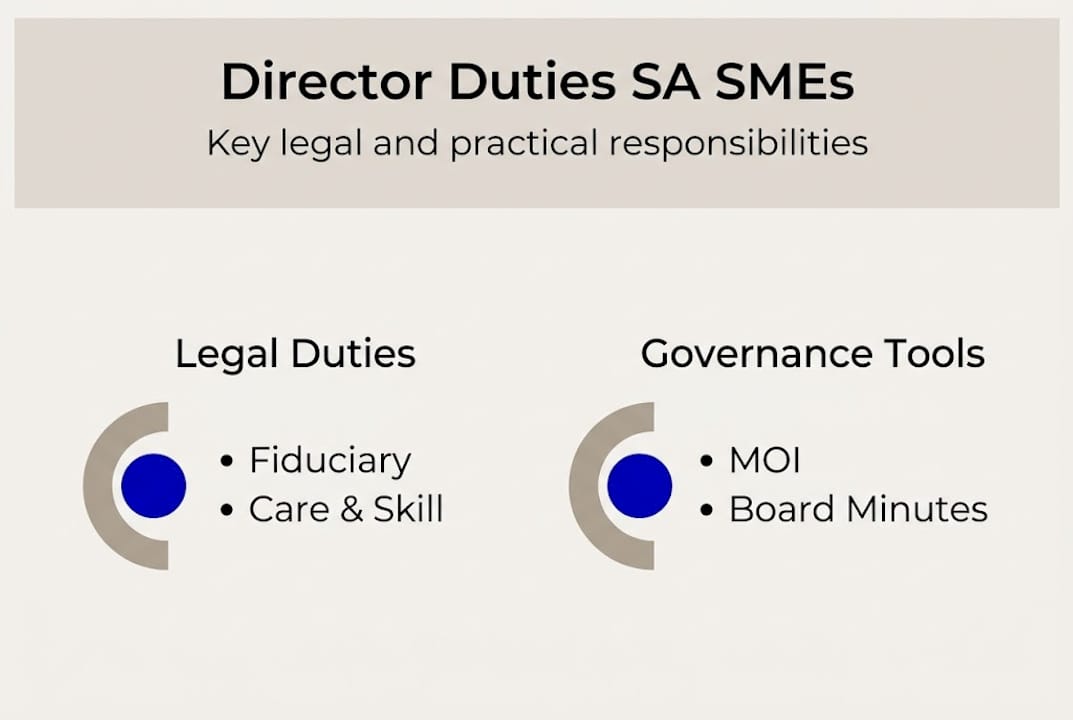
Ignorance is no longer a valid defence. CIPC’s 2026 enforcement posture makes this clear: directors are expected to know their obligations from the moment of appointment. D&O insurance fills the gap between what directors can personally afford and what a liability claim might cost.
King V, South Africa’s latest corporate governance report, shifts the emphasis from box-ticking compliance to building an ethical culture. For SMEs, this means governance should be embedded in how your business operates day-to-day, not dusted off once a year for an audit.
Annual director compliance checklist:
- Review and update the MOI if business circumstances have changed
- Confirm all director agreements are current and signed
- Verify that D&O insurance is active and covers current activities
- Hold at least one formal board meeting with documented minutes
- Review setting financial goals against actual performance
- Assess solvency and liquidity before approving any distributions
- Brief all directors on any new regulatory changes affecting the business
For SMEs focused on scaling SME strategies, strong governance is a growth enabler, not just a risk mitigation tool. Investors, lenders, and key customers increasingly assess governance quality before committing resources.
What most SME founders miss about director responsibilities
Here is the uncomfortable truth: most SME founders treat director duties as a compliance afterthought, something to worry about when problems arise rather than a framework that prevents problems in the first place. That mindset is precisely how otherwise capable founders end up with personal liability claims and five-year bans.
The tick-box approach, filing annual returns and calling it governance, provides no real protection. What actually works is building small, consistent habits: documented decisions, regular financial reviews, and periodic check-ins with a lawyer or accountant who knows your business. These habits take hours per year, not days.
Founders who start goal-setting in SMEs with governance as a pillar, not an add-on, scale more cleanly and attract better capital. The effective business structure you choose at formation sets the tone for everything that follows. Get it right early and governance becomes a competitive advantage. Get it wrong and you are managing crises instead of building a business.
The founders who navigate this best are not lawyers. They are simply people who take their director title seriously from day one.
Get expert help with director duties and compliance
Director compliance is not something you should piece together from general reading alone. At Ready Accounting, we work with South African SMEs to build the financial infrastructure that makes good governance practical and automatic. Our cloud-based systems give you real-time visibility into solvency, tax obligations, and cash flow, exactly the information a director needs to satisfy the business judgement rule and avoid reckless trading exposure. When you automate compliance and improve cash flow, you eliminate the manual gaps where governance breaks down. We also help SME directors reduce tax liability and know when it is time to hire a bookkeeper to support sustainable compliance. Book a consultation and let’s build a governance foundation that protects you.
Frequently asked questions
What are the main statutory duties of a director in South Africa?
Directors must act in good faith and uphold company interests, avoid conflicts of interest, exercise care and diligence, and serve the company’s best interests under Section 76 of the Companies Act.
When can a director be held personally liable in South Africa?
Directors are personally liable for reckless trading, tax debts, or unauthorised actions causing company losses under Section 77 of the Companies Act.
How does the business judgement rule protect directors?
Decisions made without conflicts, after diligent inquiry, and for proper company benefit are protected from liability claims by the business judgement rule under Section 76(4).
Are non-executive directors subject to the same duties?
Yes, statutory duties apply equally to executive and non-executive directors, including all fiduciary obligations and the standard of skill and care.
What practical measures can SME directors take to stay compliant?
Customise your MOI, use director agreements, insure against liability with D&O cover, and hold periodic governance reviews to maintain ongoing compliance under the Companies Act.