

How to register a company with CIPC: 2026 guide
Executive Summary
- Registering a company with CIPC makes your business a legal entity in South Africa.
- The process is handled online through BizPortal or eServices, avoiding in-person visits.
- Proper document preparation and timely payment are essential to prevent delays and rejections.
Registering a company with CIPC is the official process that establishes your business as a legal entity in South Africa. The Companies and Intellectual Property Commission (CIPC) handles all company registrations under the Companies Act 71 of 2008. You can complete the full process online through BizPortal or eServices, without visiting a CIPC office. Once approved, you receive a CoR14.3 certificate that proves your company exists in law. This guide walks you through every step, from document preparation to post-registration compliance, so you can start trading with confidence.
What you need before registering a company with CIPC
Preparation is the difference between a smooth registration and a frustrating rejection. Before you log in to BizPortal or eServices, gather every document and piece of information you will need.
Documents and information required
Required documents include certified copies of each director’s South African ID, proof of a registered office address, and a Memorandum of Incorporation (MOI). For a Private Company (Pty) Ltd, the standard MOI is the CoR15.1A template, which CIPC provides. You do not need to draft a custom MOI unless your company has unusual governance requirements.
Every detail on your documents must match exactly what you enter in the online form. A mismatch between your ID number on the form and your certified ID copy is the single most common cause of rejection. Double-check names, ID numbers, and addresses before you start.
Choosing your company type
The Private Company (Pty) Ltd is the most common structure for South African entrepreneurs. It limits your personal liability and is accepted by banks, SARS, and most suppliers. If you are unsure whether to incorporate or operate as a sole proprietor, understanding the difference between structures helps you make the right call before you commit.
Creating your CIPC customer account
You need a customer account on either BizPortal or eServices before you can register. BizPortal is the faster, simpler portal and is designed for South African ID holders. eServices serves foreign nationals and users without a South African ID. Create your account, verify your email address, and deposit funds into your CIPC customer account wallet before starting the registration.

Name reservation: is it required?
Name reservation is optional but strongly recommended. You submit up to four name choices using form CoR9.1, and CIPC issues a CoR9.4 certificate if one is approved. The name reservation fee is approximately R50 electronically, and the reservation is valid for 6 months. If you are not ready to register within that window, you can extend the reservation once for 60 business days.
Pro Tip: Reserve your company name at least two weeks before you plan to register. This gives you time to resolve any name conflicts without delaying your registration date.
Step-by-step CIPC company registration process online
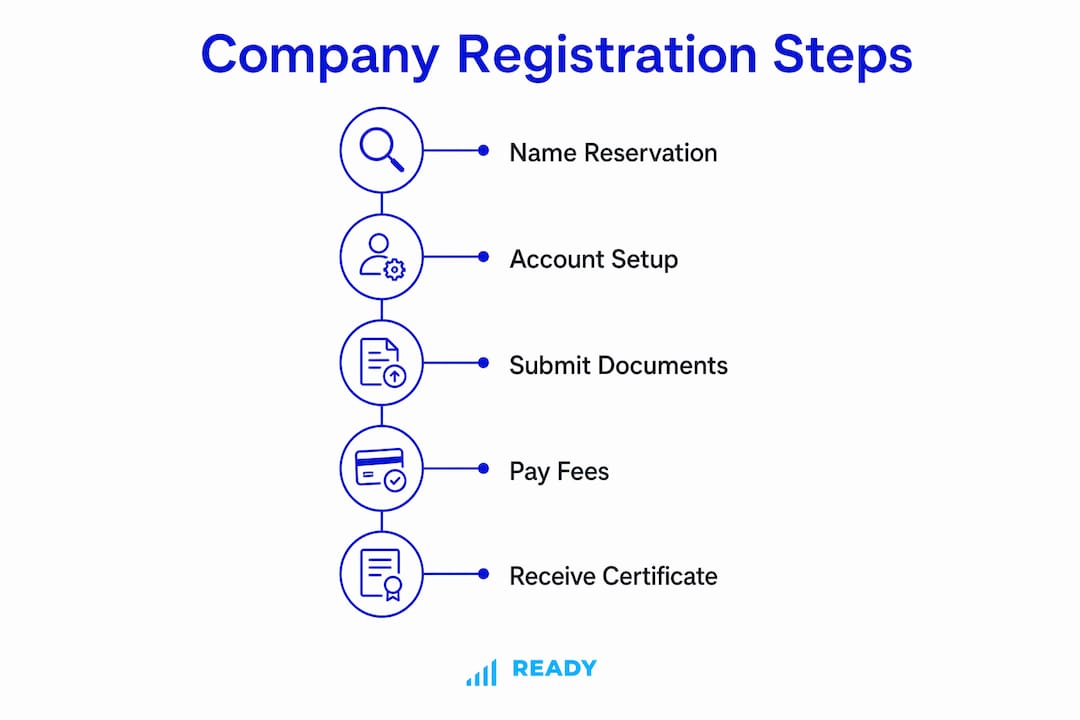
The CIPC registration process follows a clear sequence. Work through each step without skipping ahead, and you will avoid the most common delays.
-
Log in to BizPortal or eServices. Go to bizportal.gov.za if you hold a South African ID. Use eServices at eservices.cipc.co.za if you are a foreign national. Select “Company Registration” from the main menu.
-
Enter your reserved name or register without one. If you have a CoR9.4 certificate, enter the reservation number. If you skipped name reservation, CIPC will assign a registration number as your company name. You can change the name later, but it costs additional fees.
-
Verify director information. The system pulls director details directly from the Department of Home Affairs database using the ID number you enter. If your ID details are not on the Home Affairs system or contain errors, verification will fail. Foreign directors must upload their passport copies manually through eServices.
-
Submit your registered office address. This is the official address where CIPC and SARS will send legal correspondence. It must be a physical street address in South Africa, not a PO Box.
-
Select your MOI. For a standard Private Company (Pty) Ltd, select the standard CoR15.1A template. This covers the vast majority of new companies and requires no customisation.
-
Pay the registration fee. The registration fee for a Private Company (Pty) Ltd is R175. Payment is made from your CIPC customer account wallet via debit card, credit card, or EFT. You have a 5-day payment window after submitting your application. If you miss this window, your application lapses and you must start again.
-
Wait for approval and download your certificate. Processing times range from the same day up to 7 business days for online applications. CIPC notifies you by email or SMS when your application is approved. Log back in and download your CoR14.3 registration certificate immediately.
Pro Tip: Save your CoR14.3 certificate in at least two secure locations, such as cloud storage and a password-protected folder on your device. You will need it repeatedly in the first few months of trading.
| Step | Action | Cost |
|---|---|---|
| Name reservation | Submit CoR9.1 with up to 4 name choices | R50 |
| Customer account | Create and fund your BizPortal or eServices wallet | No fee |
| Company registration | Submit application with documents and MOI | R175 |
| Certificate download | Download CoR14.3 after approval | No fee |
Common mistakes that delay CIPC registration
Most rejected applications share the same handful of errors. Knowing them in advance saves you days of waiting.
- Mismatched director details. The name and ID number on your certified ID copy must be identical to what you type into the online form. Even a single character difference triggers a verification failure.
- Expired name reservation. If your CoR9.4 certificate expires before you submit your registration, your reserved name is released back into the pool. Anyone can claim it. Align your registration date with your reservation validity period.
- Missing payment within the 5-day window. The system does not send reminders. Set a calendar alert the moment you submit your application so you do not miss the payment deadline.
- Uploading blurry or uncertified ID copies. CIPC requires certified copies, not scanned originals. A commissioner of oaths, police station, or bank can certify your documents.
- Using a PO Box as your registered address. CIPC rejects PO Box addresses. Use a physical street address, even if it is your home address.
Delays frequently arise from mismatches between document details and online form inputs. A thorough review before submission is the single most effective way to reduce rejection risks.
If your application is rejected, CIPC sends a notification explaining the reason. Correct the specific issue identified, resubmit the corrected documents, and pay the fee again if required. Do not submit a brand new application unless CIPC instructs you to do so.
Essential post-registration steps for new company owners
Receiving your CoR14.3 certificate is the beginning, not the end. Several critical steps follow registration, and completing them quickly protects your company and keeps you compliant.
-
Register with SARS. Every company must register for income tax with the South African Revenue Service (SARS) within 60 days of incorporation. You will need your CoR14.3 certificate to complete this registration on the SARS eFiling portal. If your annual turnover will exceed R1 million, you must also register for VAT.
-
Open a business bank account. South African banks require your CoR14.3 certificate, your MOI, and certified director IDs to open a business account. The CoR14.3 certificate is critical during the first 30–60 days for bank, SARS, and supplier onboarding. Do not delay this step.
-
File annual returns with CIPC. Every registered company must file annual returns with CIPC each year. Missing this deadline leads to deregistration, which strips your company of its legal standing. CIPC sends reminders, but the responsibility is yours.
-
Maintain accurate company records. Keep your director registers, share registers, and registered address up to date with CIPC. Accurate records prevent fraud and protect your legal standing.
-
Set up your bookkeeping system. The moment you start trading, transactions need to be recorded. Cloud accounting tools like Xero or Sage Business Cloud connect directly to your bank account and automate the bulk of your record-keeping. Good records from day one make your first tax return far less painful.
Pro Tip: Register for SARS eFiling on the same day you download your CoR14.3 certificate. The process takes less than 30 minutes and puts you ahead of the 60-day deadline immediately.
For a broader view of your ongoing obligations, the essential steps to register a business guide from Readyaccounting covers what comes after your certificate arrives.
Key takeaways
Registering a company with CIPC requires document preparation, a funded customer account, a R175 registration fee, and prompt action on your CoR14.3 certificate to complete SARS and banking onboarding.
| Point | Details |
|---|---|
| Use BizPortal for speed | South African ID holders get faster processing through BizPortal than eServices. |
| Reserve your name early | A R50 name reservation locks your company name for 6 months and prevents conflicts. |
| Pay within 5 days | Missing the payment window lapses your application and forces you to restart. |
| Download CoR14.3 immediately | Store the certificate securely; banks and SARS require it within the first 30–60 days. |
| File annual returns on time | Missing CIPC annual returns leads to deregistration and loss of legal standing. |
What I have learned from watching entrepreneurs register with CIPC
Most entrepreneurs I work with underestimate how document-sensitive the CIPC process is. They assume the online system is forgiving. It is not. One transposed digit in an ID number, one uncertified copy, and the whole application stalls. The fix is always the same: prepare every document before you open BizPortal, not during.
The choice between BizPortal and eServices trips people up more than it should. If you hold a South African ID, use BizPortal. The interface is cleaner, the Home Affairs verification is faster, and approvals tend to come through quicker. eServices exists for a reason, but it is not the path of least resistance for local founders.
The CoR14.3 certificate deserves more respect than most new business owners give it. Entrepreneurs often underestimate how important it is as the key document to open bank accounts and register for SARS services. I have seen founders lose weeks of trading time because they could not open a business account without a certificate they had not yet downloaded. Download it the moment CIPC approves your application.
Finally, the registration itself is just the starting line. The companies that stay compliant and grow are the ones that treat CIPC registration as the first item on a longer compliance checklist, not the last. Get your SARS registration done, open your business account, and set up your bookkeeping before your first invoice goes out.
— Johan
How Readyaccounting supports your business after CIPC registration
Getting your CoR14.3 certificate is a milestone. What happens next determines whether your company stays compliant and grows. Readyaccounting works with South African SMEs and startups to replace manual bookkeeping with cloud infrastructure that gives you real-time visibility into your cash flow. From VAT registration and SARS compliance to automated financial reporting, the team acts as your Fractional CFO from the moment you start trading. Understanding how automation improves cash flow shows you exactly what is possible when your finance function runs on current technology instead of spreadsheets. Readyaccounting also helps with record keeping requirements so your CIPC compliance never lapses.
FAQ
What does it cost to register a company with CIPC?
The registration fee for a Private Company (Pty) Ltd is R175. Name reservation costs an additional R50 if you choose to reserve a name before registering.
How long does CIPC registration take?
Online registration through BizPortal or eServices takes between the same day and 7 business days. CIPC notifies you by email or SMS when your application is approved.
Can I register a company with CIPC without a South African ID?
Yes. Foreign nationals use the eServices portal and upload passport copies manually instead of using the Home Affairs ID verification system.
What is the CoR14.3 certificate?
The CoR14.3 is your official company registration certificate issued by CIPC. Banks, SARS, and suppliers require it to verify your company’s legal existence.
Do I need to reserve a company name before registering?
Name reservation is optional. You can register without a reserved name and CIPC will assign your registration number as the company name, which you can change later at an additional cost.