

Register your company in South Africa: a clear guide
Executive Summary
- Starting a business in South Africa requires thorough preparation of documents and understanding the registration process to avoid delays. After registration, activating tax numbers and planning for VAT and PAYE compliance are critical for seamless trading and growth. Using official portals and implementing automation tools help ensure ongoing compliance and prevent costly penalties.
Starting a business in South Africa is exciting, but the registration and tax compliance process trips up more founders than it should. A single mismatched detail on your CIPC submission can delay your company registration by weeks, and skipping the post-registration tax steps can land you with penalties before you’ve even opened a business bank account. This guide walks you through everything you need: the right documents, the correct online portals, the exact sequence for tax activation, and the specific thresholds that determine when VAT and PAYE registration become mandatory. Follow this process step by step and you’ll launch compliant, confident, and ready to trade.
Table of Contents
- What you need before you start: preparation and prerequisites
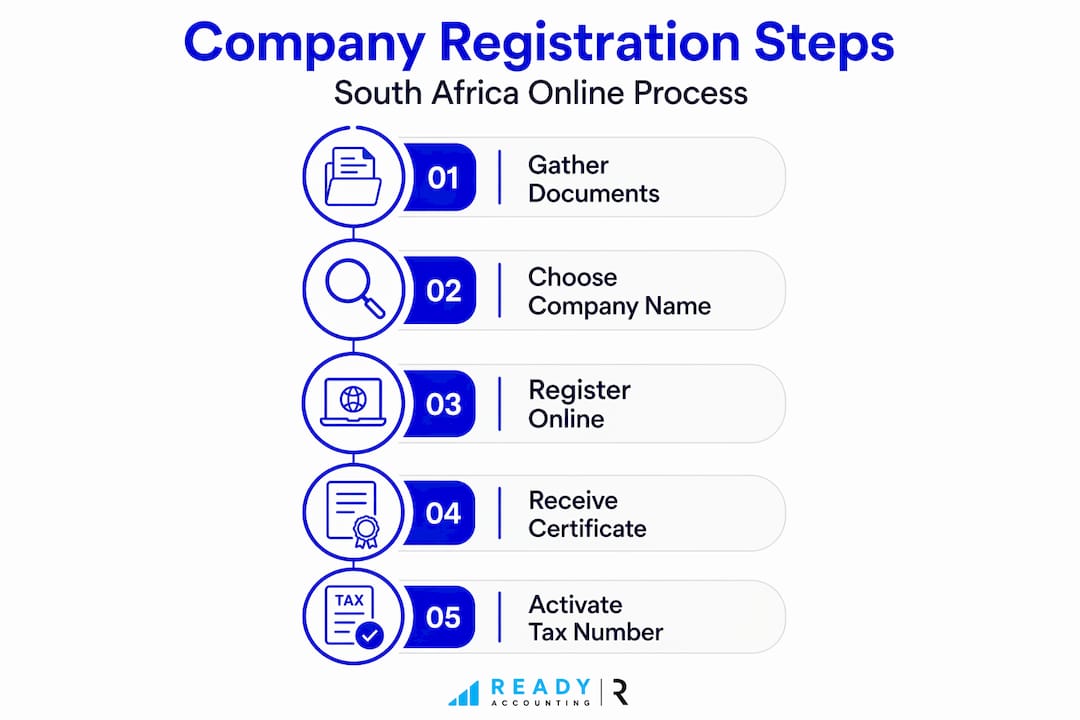
- Step-by-step company registration process
- Tax number activation and SARS eFiling essentials
- Registering for VAT and additional tax types
- How to avoid delays and common mistakes in registration
- A practical perspective: what matters most for South African SMEs
- Secure your compliant launch with expert support
- Frequently asked questions
Key Takeaways
| Point | Details |
|---|---|
| Document readiness | Gather all certified IDs and address proofs before starting to avoid delays. |
| Follow the right sequence | Register with CIPC, secure your tax number, then activate SARS eFiling for compliance. |
| Monitor VAT thresholds | VAT registration is compulsory if you go over R2.3 million in turnover in 2026. |
| Avoid common errors | Consistent details and timely uploads save weeks spent on corrections. |
| Get expert support | Professional guidance can streamline your setup and help you stay compliant long term. |
What you need before you start: preparation and prerequisites
Start by ensuring you have all critical documents and details in place, as missing paperwork is the fastest way to run into delays and rejections.
Most companies registering with CIPC stall at the submission stage, not because the process is complicated, but because founders arrive unprepared. The essential steps to register a business in South Africa all trace back to one root principle: preparation before the portal, not during it. As registration guidance for SMMEs consistently emphasises, preparing director identity and address documentation upfront is the single most effective way to avoid rejections.
Required documents at a glance
| Document | Details required |
|---|---|
| Director ID copies | Certified copy of SA ID or valid passport for each director |
| Proof of registered office address | Utility bill or lease agreement, not older than 3 months |
| Company name options | At least 2 choices in priority order |
| CoR14.1 form | Memorandum of Incorporation (MOI), completed accurately |
| Director contact details | Email addresses and phone numbers for each director |
| Payment method | Credit or debit card for online registration fees |
Common documentation mistakes to avoid
- Submitting uncertified ID copies instead of certified ones
- Using a residential address that doesn’t match the proof of address document
- Choosing a company name already in use or too similar to an existing registration
- Providing director details that differ slightly between the form and the uploaded ID
- Uploading low-resolution scans that fail the portal’s verification checks
- Forgetting to list a second company name option, which causes unnecessary delays
Pro Tip: Always scan and save high-quality PDFs of every certified document before you begin. Blurry uploads are rejected automatically, and resubmitting costs you days.
The three tools you’ll interact with are BizPortal (the simplified public-facing registration site), CIPC eServices (the older but feature-rich portal), and SARS eFiling (for all tax-related registrations after incorporation). Each serves a distinct purpose, and knowing which one handles what saves you from logging into the wrong system mid-process.
Step-by-step company registration process
With all documents assembled, move step-by-step through the digital company registration process.
Company registration in South Africa is done online, and for most private companies (Pty Ltd), the process runs through CIPC. According to SARS guidance for small businesses, registration is completed via CIPC channels and culminates in the issue of a CoR14.3 registration certificate once approved.
BizPortal vs CIPC eServices: which should you use?
| Feature | BizPortal | CIPC eServices |
|---|---|---|
| Ease of use | Beginner-friendly, guided UI | More technical, requires familiarity |
| Name reservation | Included in registration flow | Separate step required |
| Annual return filing | Not supported | Fully supported |
| Processing speed | Generally faster | Comparable, but more options |
| Simultaneous registrations | Yes (e.g., CIPC + tax) | Separate processes |
| Best for | First-time registrants | Businesses needing full CIPC access |
The registration workflow
-
Create your CIPC account. Go to BizPortal or CIPC eServices and register as a user. You’ll need a valid email address and mobile number. Verify your account before proceeding.
-
Reserve your company name. Submit your preferred name choices. CIPC checks for uniqueness and similarity. This typically takes 24 to 48 hours. Have your second choice ready in case the first is rejected.
-
Complete the CoR14.1 form. This is your company’s Memorandum of Incorporation. Fill in director details, share structure, and registered address. Every field must match your uploaded documents exactly.
-
Upload supporting documents. Attach certified ID copies, proof of registered address, and any additional director documentation. Use high-quality PDFs.
-
Pay the registration fee. Fees are paid online via card. Costs vary depending on whether you reserve a name separately or as part of a package. Always confirm current fees on the official CIPC site before starting.
-
Wait for approval. CIPC reviews the submission. Standard turnaround is 5 to 7 business days when documentation is complete. Incomplete or mismatched submissions can push this to 3 to 4 weeks.
-
Download your CoR14.3 certificate. This is your official proof of company registration.
Important: Your CoR14.3 registration certificate is your only legally valid proof of incorporation. Do not enter into business contracts, open bank accounts, or transact as a company until this certificate is in your hands.
Pro Tip: Make sure your company name and every director’s detail match your documents precisely. A single letter difference between your ID and your form submission will trigger a rejection and restart the clock.
The critical company registration actions most often overlooked are the ones that happen between submission and certificate. Check your email and CIPC portal notifications daily during the waiting period. Missed queries from CIPC add weeks to your timeline.
Tax number activation and SARS eFiling essentials
Once your company is officially on record, you must ensure it is ready to transact with SARS for tax compliance.
Here’s what many new founders don’t know: you don’t apply separately for a company income tax number. After CIPC registration, SARS automatically generates an income tax reference number and sends it to the email address captured during the registration process. But receiving that number is only the beginning. You still need to actively register on SARS eFiling before your company can file returns, submit documents, or respond to SARS correspondence.
Steps to activate your company on SARS eFiling
- Go to the official SARS eFiling portal and click “Register.”
- Select “Register as a new user” and provide your personal information as the registered representative.
- Once your personal profile is active, link your company’s income tax reference number to your eFiling profile.
- Assign yourself as the company’s registered representative or tax practitioner.
- Set up user permissions if you’re sharing eFiling access with a bookkeeper or accountant.
- Confirm all company details match the information CIPC submitted to SARS.
eFiling setup tips
- Keep your income tax reference number email from SARS. You’ll need it to link your company.
- Use a dedicated business email address for SARS correspondence, not a personal Gmail account.
- Set up two-factor authentication immediately to protect your eFiling account.
- Download and store your eFiling registration confirmation as soon as it’s available.
- Ensure the company’s banking details are updated on eFiling before submitting any returns.
Pro Tip: Do not open a business bank account or sign supplier agreements before your SARS income tax number is active and linked to eFiling. Some banks now require the tax reference number as part of their account opening process, so having it ready speeds up everything downstream.
Skipping the eFiling setup doesn’t just delay tax compliance, it blocks all communication between your company and SARS. That creates a dangerous blind spot where your company accumulates filing obligations you’re not even aware of. Understanding how to avoid tax compliance failure starts right here, at the eFiling stage.
Registering for VAT and additional tax types
After activating your SARS eFiling, complete all required post-incorporation tax registrations so your business can trade and hire compliantly.

The most misunderstood part of post-registration compliance is timing. Many founders think they register for tax types “later, when it becomes relevant.” In reality, missing a registration deadline triggers automatic penalties from SARS, and ignorance is not a valid defence.
2026 tax registration thresholds
| Tax type | Trigger | Threshold / criteria |
|---|---|---|
| Income tax | Automatic after CIPC registration | No threshold, always required |
| VAT (compulsory) | Taxable turnover in any 12 months | R2.3 million |
| VAT (voluntary) | Any 12-month taxable turnover | R120,000 |
| PAYE | Hiring employees above tax threshold | Based on employee earnings |
| UIF | Employing any staff | All employees, no minimum |
| SDL | Annual leviable payroll | R500,000 per year |
The compulsory VAT threshold for 2026 is R2.3 million in taxable turnover over any rolling 12-month period. Voluntary registration is possible from R120,000. Both are significant numbers that fast-growing SMEs can hit earlier than expected. SARS guidance makes clear that businesses must plan these registrations as part of their broader post-CIPC compliance sequence.
Correct sequence for tax type registrations
- Complete CIPC registration and receive your CoR14.3 certificate
- Wait for SARS to issue your income tax reference number via email
- Activate your company on SARS eFiling and confirm the income tax profile
- Register for PAYE and UIF as soon as you hire your first employee
- Register for VAT once you cross R120,000 (voluntary) or approach R2.3 million (compulsory)
- Register for SDL once your annual leviable payroll exceeds R500,000
Important: You must register for VAT within 21 business days of crossing the compulsory threshold. Missing this window results in back-dated VAT liability plus penalties. Review the full VAT registration guide to understand exactly what triggers a registration obligation in your specific business model.
These thresholds and requirements do shift over time. Always verify the latest figures directly from SARS before making registration decisions, especially if you’re operating in a high-growth phase where your revenue is moving fast.
How to avoid delays and common mistakes in registration
With the main process complete, awareness of common mistakes and how to sidestep them is essential for a smooth business launch.
Top five mistakes that stall registration
- Incomplete forms: Leaving fields blank or skipping optional-but-important sections on the CoR14.1
- Mismatched details: Director names, ID numbers, or addresses that differ between the form and uploaded documents
- Skipped tax registrations: Completing CIPC but ignoring PAYE or VAT until a SARS query arrives
- Delayed eFiling setup: Waiting weeks after receiving your tax number to activate your eFiling profile
- Using unverified portals: Falling for third-party sites that mimic CIPC, charge inflated fees, and submit incorrectly
The biggest compliance risk for new businesses is not the mechanics of company incorporation. It’s the post-registration tax activation steps that most SMEs underestimate. Getting your CoR14.3 feels like the finish line. It’s actually the starting gun.
Efficiency in registration comes from using the correct tools. As registration best practices confirm, sticking to official portals like BizPortal or CIPC eServices and ensuring director identification is consistent with uploaded documents eliminates the most common rejection reasons.
Pro Tip: Save every email from CIPC and SARS. Download every certificate and confirmation the moment it becomes available. Lost documents can add weeks to your timeline, and requesting reissues from either institution is a slow, manual process.
Use a simple checklist at each stage: pre-submission, post-submission, post-certificate, and post-tax activation. The company registration execution framework that works for scaling SMEs is built on documentation discipline, not guesswork.
A practical perspective: what matters most for South African SMEs
Most guides on company registration obsess over incorporation mechanics. Which form to fill in. Which portal to use. How long the queue is. But in our experience working with scaling South African businesses, the mechanics of getting your CoR14.3 are almost never where things go seriously wrong.
The real risk lives in the 60 days after registration. That’s when founders, relieved that the “hard part” is done, miss critical eFiling setup windows, ignore SARS emails they don’t understand, and forget to register for PAYE when they hire their first team member. By the time a tax problem surfaces, months of non-compliance have accumulated.
What separates the founders who scale cleanly from those who spend Q2 firefighting SARS penalties? Two things consistently. First, they treat registration and tax activation as a single continuous project, not two separate events. Second, they automate the monitoring. They don’t rely on memory to track VAT thresholds or provisional tax deadlines. They use software, alerts, or professional advisors who flag obligations before they become penalties.
We’ve seen businesses with R5 million in annual revenue still running their compliance on sticky notes and email reminders. The tax compliance lessons that matter most aren’t about knowing the rules. They’re about building systems that keep you compliant without demanding your constant attention.
Pro Tip: Invest in software or a professional service that automates compliance reminders from day one. The monthly cost is a fraction of a single SARS penalty. More importantly, it frees your attention for revenue-generating activity instead of administrative firefighting.
The founders who thrive long-term view their compliance infrastructure the same way they view their sales pipeline: as something that needs active management, not reactive patching.
Secure your compliant launch with expert support
Getting your company registered is just the foundation. The businesses that grow without being derailed by SARS penalties, missed filings, or compliance surprises are the ones that build expert support into their operations from the start. At Ready Accounting, we specialise in exactly this. From handling your company registration sequence to automating your post-incorporation tax compliance, our cloud-based systems and Fractional CFO support ensure nothing falls through the cracks.
If you want to reduce your tax liability from the moment your company is active, or if you’re looking for a trusted outsourced accounting partner who treats your finances as a growth engine rather than an admin burden, let’s talk. Book a consultation and find out how much time and money you can recover by getting compliance right the first time.

Frequently asked questions
Which documents must I prepare for company registration in South Africa?
You need certified ID copies and proof of address for every director, along with at least two company name options and a completed CoR14.1 form ready to upload before you begin.
When does my business need to register for VAT in 2026?
Register compulsorily if your taxable turnover exceeds R2.3 million in any 12-month period, or register voluntarily once you reach R120,000 in taxable turnover.
Do I get a tax number automatically when registering a company?
Yes, SARS auto-generates a company income tax reference number after your CIPC registration is approved, and sends it to the email address on record.
What’s the fastest way to avoid delays in registration?
Prepare all director and company details before touching the portal, and ensure every field on your form matches your uploaded documents exactly to prevent automatic rejection.
Where do I access the official online company registration services?
Use BizPortal or CIPC eServices for official company registration. Avoid third-party sites that mimic these portals, as they often charge inflated fees and submit incorrectly on your behalf.