

Essential steps to register a business in South Africa
Executive Summary
- Starting a business requires separate registration with CIPC for legal status and SARS for tax compliance.
- Foreigners can own 100% of a South African business by registering through CIPC eServices.
- Proper record-keeping and early automation are crucial for ongoing compliance and business growth.
Starting a business in South Africa is exciting, but the registration process trips up even the most driven entrepreneurs. Between CIPC, SARS, BizPortal, and a maze of forms, many founders waste weeks on avoidable errors or end up non-compliant without knowing it. The real cost is not just time: penalties, rejected applications, and delayed trading can set a new business back months. This guide cuts through the confusion with a clear, step-by-step breakdown of every major registration requirement, so you can launch legally, confidently, and without unnecessary delays.
Table of Contents
- Understand the key requirements before you start
- Step-by-step guide: registering your business entity
- Register for tax and compliance with SARS
- Get your records and financial systems in order
- What most guides miss: the human and digital factors of business registration
- Streamline your registration and financial setup with expert help
- Frequently asked questions
Key Takeaways
| Point | Details |
|---|---|
| Know your business type | Different entity types have different legal and tax requirements in South Africa. |
| Register with the right authorities | Companies use CIPC, but every business, including sole proprietors, must register with SARS for tax. |
| Prepare documents early | Gather identification, address proof, and company details in advance to avoid delays. |
| Adopt digital systems | Using cloud accounting from the start simplifies compliance and record-keeping. |
| Ongoing compliance matters | Proper systems and support help avoid penalties and keep your business running smoothly. |
Understand the key requirements before you start
Before you touch a single online form, understand what type of business you are registering and what that means for your documentation. South Africa has several business structures, and each one has different registration obligations. Getting this wrong at the start is the single most common mistake new founders make.
The main business structures and what they require:
- Sole proprietor: You trade under your own name. No CIPC registration is needed, but you are legally required to register with SARS for tax purposes.
- Private company (Pty) Ltd: Must register with CIPC and then separately with SARS for a tax number.
- Partnership: No formal registration required, but a written partnership agreement is strongly advised.
- Non-profit company (NPC): Registered with CIPC but operates under different rules than a for-profit entity.
- Co-operative: Registered under the Co-operatives Act, not through CIPC’s standard process.
The legal distinction between CIPC and SARS registration confuses most people. CIPC, the Companies and Intellectual Property Commission, gives your company legal existence. SARS, the South African Revenue Service, makes you tax-compliant. You need both. They are completely separate processes with separate timelines.

Documents you will need, regardless of structure:
| Document | Sole Proprietor | Private Company (Pty Ltd) | Foreign Founder |
|---|---|---|---|
| South African ID or passport | Yes | Yes | Passport required |
| Proof of residential address | Yes | Yes | SA address required |
| Tax number (personal) | Yes | Director’s tax number | Yes |
| Company name reservation | No | Yes (via CIPC) | Yes (via CIPC eServices) |
| Memorandum of Incorporation | No | Yes | Yes |
Important: As legal requirements confirm, sole proprietors need SARS registration but not CIPC, while foreigners can own 100% of a South African business but must register using CIPC eServices specifically, not BizPortal. Non-residents are also required to provide a valid South African address as part of the process.
One edge case worth knowing: if you are a foreign national running a sole proprietorship, the rules shift again. You will need a valid passport, proof of a South African address, and in some cases, a valid work or business visa. The specific visa category matters because it affects what types of economic activity you can legally conduct.
Pro Tip: Get certified copies of all your identity documents before you begin. CIPC and SARS both require certification, and having multiple copies ready saves you from running back to the post office halfway through your application.
The CIPC registration protocol for private companies has also changed significantly since the introduction of digital services. Understanding whether you qualify for BizPortal or must use CIPC eServices can determine whether your application takes two days or two weeks.
Step-by-step guide: registering your business entity
Once you know what structure you are using and which documents you need, the actual registration process becomes much more manageable. Let’s walk through each common scenario clearly.
Registering a private company (Pty Ltd) using BizPortal:
- Go to BizPortal and create an account using your South African ID number.
- Search for and reserve your preferred company name. CIPC charges a small fee for name reservation.
- Complete your company registration application, including director details and the Memorandum of Incorporation (MOI).
- Pay the registration fee (currently R125 for standard registration).
- Wait for CIPC to process the application. Timelines range from 5 to 10 business days under normal conditions.
- Download your registration documents, including your company registration certificate and COR14.3 (directors’ details).
Registering as a sole proprietor:
There is no formal CIPC application for sole proprietors. Instead, you simply operate under your full legal name. However, if you want to trade under a different name, you will need to register a trading name. This is a separate, simpler process. After that, your priority is SARS registration, which we cover in the next section.
What about BizPortal versus CIPC eServices?
| Feature | BizPortal | CIPC eServices |
|---|---|---|
| Who can use it | SA citizens and residents with SA ID | Foreign nationals and non-residents |
| Registration speed | 5 to 10 business days | Similar, but manual verification adds time |
| Name reservation | Yes | Yes |
| Online payment | Yes | Yes |
| Preferred for | Local founders | Foreign founders |
As the legal framework confirms, sole proprietors do not register with CIPC at all, but foreign founders must specifically use eServices rather than BizPortal. This is not optional. Applications from foreign nationals submitted via BizPortal are typically rejected, which creates delays of several weeks.
The process of registering a company has become significantly more accessible since BizPortal launched, but it still requires careful attention to detail. Small errors in your MOI or director information can result in rejection, meaning you start the process again from scratch.
Pro Tip: Before submitting your company name, do a thorough search on CIPC’s database to confirm it is not already taken or too similar to an existing registered name. CIPC can reject names that are confusingly similar to existing registrations, even if the spelling differs slightly.
One thing many new founders miss: once your company is registered with CIPC, you receive your company registration number. This number is not your tax number. You still need to register with SARS separately to get your income tax reference number. These are two different identifiers used for two different purposes. Understanding this distinction upfront prevents significant confusion later. Review the company registration steps in detail if you are handling this process yourself.
Register for tax and compliance with SARS
With your business entity legally established, tax registration is your most urgent next step. Many entrepreneurs make the mistake of starting to trade before completing this phase, which creates backdated compliance problems that are painful to resolve.
Step-by-step SARS registration for a new business:
- Log in to or create an account on eFiling, SARS’s online tax platform.
- Register your new company or sole proprietorship as a taxpayer under the relevant income tax category.
- Receive your income tax reference number. For companies, this is separate from your personal tax number.
- Register for PAYE (Pay As You Earn) if you plan to hire employees, even part-time workers.
- Register for VAT if your annual turnover meets or will meet the R1 million threshold. Voluntary registration is possible from R50,000.
- Register for UIF (Unemployment Insurance Fund) contributions if you have employees.
As legal guidance confirms, sole proprietors need SARS tax registration even though no CIPC process is required. This is one of the most frequently overlooked steps. Because sole proprietors do not go through a formal company registration, they sometimes assume their personal tax registration is sufficient. It is not. Your business income must be declared under your personal tax return, but the registration and categorisation still need to reflect your business activity correctly.
Common compliance pitfalls to avoid:
- Registering late: SARS expects registration within 60 days of commencing business activity. Late registration can result in penalties.
- Missing VAT thresholds: If your turnover crosses R1 million and you have not registered for VAT, you are technically non-compliant from the moment you crossed that threshold.
- Ignoring provisional tax: As a business owner, you are likely a provisional taxpayer. This means two mandatory tax payments per year, plus a final return. Missing these attracts interest and penalties.
- Using personal bank accounts: SARS and auditors view this as a red flag. Open a dedicated business account immediately after registration.
Pro Tip: Register for eFiling on the same day you receive your CIPC registration certificate. The sooner you are in the SARS system, the less risk of compliance gaps. You can also link your accountant or tax practitioner to your eFiling profile, giving them access to file on your behalf.
Understanding your ongoing business tax returns process from day one prevents the kind of backlog that forces entrepreneurs to pay accountants double to untangle two years of missed filings. For a broader picture, the small business tax protocol covers the full landscape of what you owe and when you owe it.
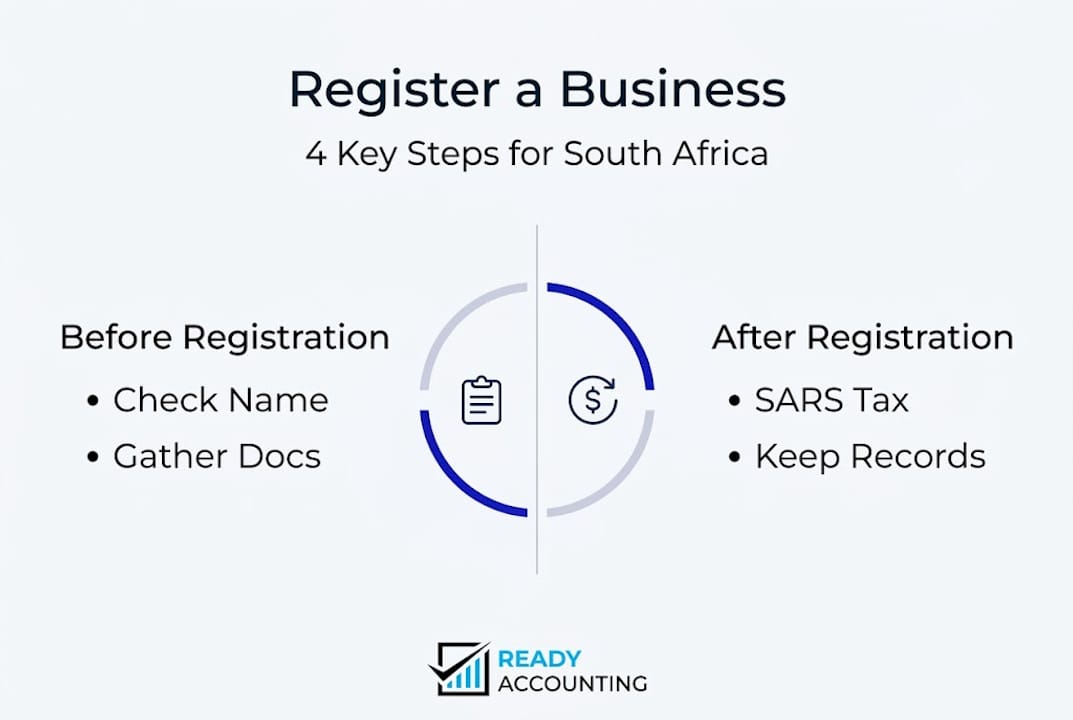
If you have questions about specific tax scenarios, from deductible expenses to turnover tax for micro-businesses, the small business tax questions resource addresses the most common ones South African founders face. SARS does have a Small Business Amnesty framework and instalment arrangements for those who are behind, but prevention is always cheaper than remediation.
Get your records and financial systems in order
Legal registration and tax compliance are the foundation. But the businesses that scale cleanly are those that build strong financial systems from day one, not six months down the line when the admin chaos becomes unmanageable.
What records you must keep and for how long:
- Financial statements: Income statements, balance sheets, and cash flow statements for every financial year.
- Bank statements: All business accounts, kept for a minimum of five years.
- Invoices and receipts: All purchase and sale records, including electronic ones.
- Payroll records: If you have employees, records of salaries, deductions, and UIF contributions.
- VAT records: If VAT-registered, every input and output VAT transaction must be documented.
- Contracts and agreements: Including supplier, client, and employment contracts.
As the legal framework notes, non-residents must provide a South African address for compliance. This is not just a registration formality. It affects where official correspondence is sent, including SARS assessments and CIPC annual return notices. If you miss those communications because your address is outdated, you face penalties for non-response, even if you were unaware.
The compliance reality: SARS has the legal authority to conduct audits going back up to five years from the date of assessment. Businesses without proper records face estimated assessments, which almost always result in a higher tax bill than the actual liability.
Why cloud-based systems change everything:
Manual bookkeeping with spreadsheets creates risk. A single formula error, a missing entry, or a lost receipt can unravel months of records. Cloud accounting systems like Xero and QuickBooks Online automatically sync with your bank account, categorise transactions, and generate reports that are audit-ready at any time.
Pro Tip: Set up your cloud accounting system before you make your first business transaction. Retrofitting six months of transactions into a new system costs far more in time and accountant fees than setting it up correctly from the start.
Understanding the SARS record-keeping rules in detail helps you avoid the most common compliance mistakes. Many founders do not realise that electronic records must be in a format that SARS can read and verify. Scanned documents saved in a folder on your laptop do not always qualify.
The accountants’ role in compliance has also evolved considerably. A good accountant today is not just someone who files your returns. They are a strategic advisor who spots risk, identifies tax savings, and ensures your financial systems support growth rather than obstruct it.
What most guides miss: the human and digital factors of business registration
Most registration guides stop at the paperwork. They tell you which forms to fill in and which office to contact, and then they leave you to figure out the rest. That is where the real problems begin.
Registration is a moment in time. What follows is an ongoing commitment to compliance, financial management, and adaptive record-keeping. Founders who treat registration as a checkbox exercise almost always hit a wall within the first two years. A missed provisional tax payment, an outdated address with CIPC, or an unreconciled VAT return can unravel a business that is otherwise performing well.
The shift we see at Ready Accounting is this: founders who invest in cloud infrastructure and automated financial systems from the start have more time to focus on growth, face fewer SARS queries, and have cleaner books when they need funding or investment. It is not about spending more on accounting. It is about spending smarter, earlier.
The business support role of a modern accountant is to sit alongside founders as a strategic partner, not just appear at year-end to file. Digital tools make that partnership more accessible and more effective than ever before.
Streamline your registration and financial setup with expert help
You now have a clear picture of what registration involves and what comes after it. The next move is making sure you do not navigate this alone. Ready Accounting specialises in supporting South African entrepreneurs through every phase of business setup, from registration to fully automated financial management. Our cloud-based systems remove the manual burden, reduce the risk of compliance errors, and give you real-time visibility into your business finances. Explore our accounting automation guide to see how automation changes the game, discover the cloud accounting benefits that give small businesses a competitive edge, and find out how to lower your tax burden with our tax reduction for SMEs strategies.
Frequently asked questions
Do I need to register with CIPC or just with SARS if I’m starting as a sole proprietor?
Sole proprietors do not need CIPC registration but must register with SARS for tax purposes to be legally compliant from day one.
Can foreigners own 100% of a South African business?
Yes, foreigners can own 100% of a South African business but must register through CIPC eServices specifically, not BizPortal, which is reserved for SA ID holders.
What documents do non-residents need to register a business in South Africa?
Non-residents must provide proof of a South African address alongside their passport and other standard registration documents as part of the compliance process.
What’s the difference between CIPC and SARS in business registration?
CIPC gives your business its legal identity as a registered entity, while SARS registers your business for tax compliance. They are separate processes with separate timelines and serve entirely different functions.