

Managing accounts receivable: a practical guide for South African SMEs
Managing accounts receivable: a practical guide for South African SMEs
Poor cash flow kills more South African businesses than poor sales do. Managing accounts receivable, the formal process of overseeing customer credit, invoicing, collections, and cash application, sits at the heart of that problem. Your accounts receivable (AR) is the money customers owe you for goods or services already delivered. It lives on your balance sheet as a current asset, but it only becomes real cash when you collect it. African SMEs face chronic payment delays that inflate operational costs and choke working capital, and the businesses that survive are the ones that treat AR as a managed process, not an afterthought.
Effective AR management covers five interconnected activities:
- Assessing customer credit risk before extending terms
- Issuing accurate, timely invoices that meet SARS VAT requirements
- Following up on outstanding balances with a structured communication sequence
- Monitoring performance through ageing reports and key metrics
- Escalating overdue accounts through legal channels when necessary
South Africa’s standard credit term is 30 days from invoice date, with a written stop-supply policy triggered at 60 days overdue. Entities like SARS, CIPC, and the Small Claims Court all play roles in the AR ecosystem, from VAT compliance on invoices to verifying debtor legitimacy to recovering smaller debts without expensive litigation. Get this process right and your working capital stays healthy. Let it slide and you are profitable on paper while unable to pay your staff.
Table of Contents
- How the accounts receivable management process actually works
- Best practices that actually reduce overdue accounts
- How do you measure accounts receivable performance?
- How technology makes AR management faster and more reliable
- Legal considerations and compliance in South African AR management
- Readyaccounting takes the AR burden off your plate
- Key takeaways
How the accounts receivable management process actually works
AR management is not a single task. It is a chain of five steps, and a weak link in any one of them slows the whole cycle.
Step 1: Credit approval
Before you sell on credit, you need to know who you are selling to. Verifying a client’s entity status via CIPC before extending credit is one of the most effective ways to reduce bad debt risk. Beyond CIPC, run a credit bureau check through TransUnion or Experian, request three months of bank statements, and ask for trading references. Tier each customer as low, medium, or high risk, then set a credit limit and payment terms accordingly. Record everything in your AR system.
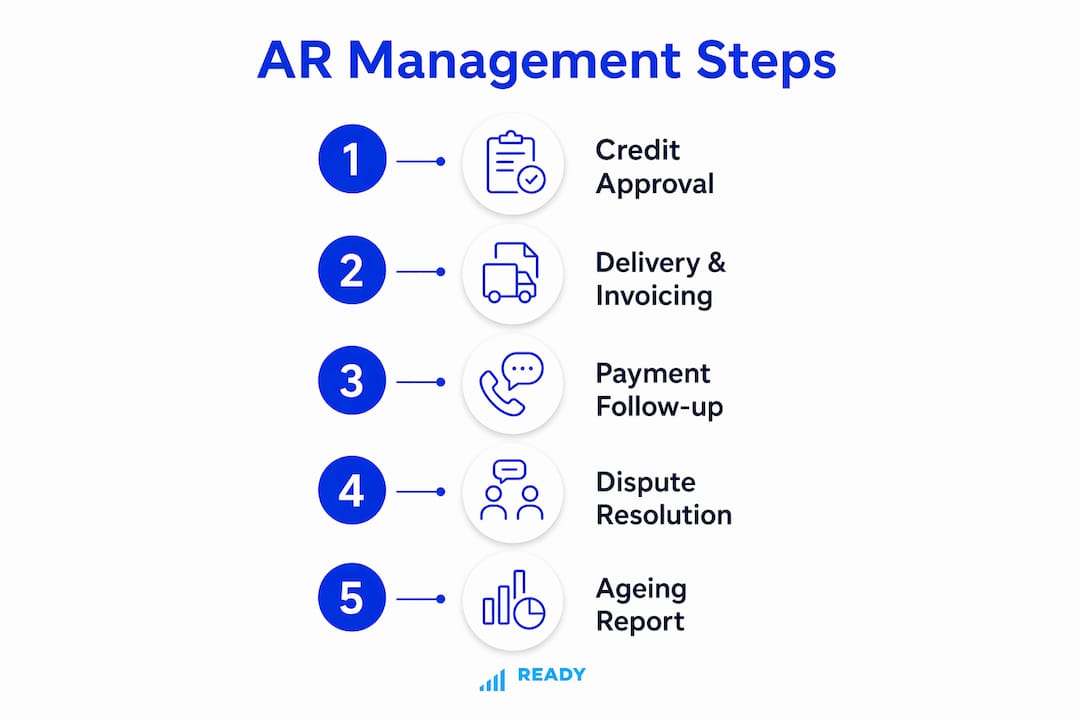
Step 2: Delivery and invoicing
Issue your invoice within one to two days of delivery. Every South African VAT-registered business must include its VAT number, the customer’s legal entity name, a unique invoice number, line-item descriptions, and the VAT amount on every tax invoice. Small errors here, like addressing the invoice to the wrong legal entity, can delay payment by weeks while the client’s accounts department queries it.
Step 3: Payment follow-up
Automated reminder sequences remove the human memory problem entirely. A well-structured sequence runs: a polite email seven days before the due date, a clear “overdue” notification on day one after the due date, a firmer follow-up on day seven, and internal escalation from day fourteen. Issuing monthly statements on the first of each month is standard practice among South African corporates, because many finance departments pay from statements rather than individual invoices.

Step 4: Dispute resolution
Not every late payment signals a bad debtor. Pricing mismatches, delivery disputes, and invoice errors are common causes of delay. Set up a single disputes channel, a dedicated email address or phone number, with a 48–72 hour response commitment. Log every dispute with the customer name, invoice number, reason, and resolution status. Resolving disputes quickly keeps the relationship intact and removes the debtor’s excuse for non-payment.
Step 5: Ageing report and escalation
The ageing report is your primary monitoring tool. Standard South African buckets look like this:
| Ageing bucket | Status | Recommended action |
|---|---|---|
| Current | Not yet due | Send friendly pre-due reminder |
| 1–30 days overdue | Early stage | Polite phone call, confirm receipt |
| 31–60 days overdue | Moderate risk | Formal letter of demand, stop supply |
| 61+ days overdue | High risk | Escalate to credit manager or attorney |
| 90+ days overdue | Critical | Hand over to debt collector or court |
Pro Tip: Assign one person to own the debtors book. Not “accounts” as a department. One named individual who reviews the ageing report every week and is measured on the outcome.
Best practices that actually reduce overdue accounts
The businesses with the healthiest AR are not necessarily the ones with the best customers. They are the ones with the clearest policies.
Write a credit policy and get it signed
Your credit policy should be a formal document that every new commercial client signs before you extend terms. It must define payment terms (e.g., “30 days from invoice date”), the credit limit, late-payment interest or penalties, and the point at which the account will be handed over for collection. Vague terms are an open invitation for late payment. When the rules are written down and signed, disputes about what was agreed become rare.
Use the 2/10 Net 30 incentive
Offering a 2% discount for payment within 10 days gives clients a concrete reason to prioritise your invoice. It costs you a small margin but shortens your cash conversion cycle, which is often worth more than the discount itself.
Call before the due date
A proactive call seven days before the due date often surfaces problems early, a missing purchase order number, an incorrect VAT amount, a query from the client’s accounts department, that would otherwise cause the invoice to sit unpaid past the due date. This single habit prevents more late payments than any reminder email.
Follow a structured escalation timeline
A defined escalation pathway with clear actions at each stage dramatically improves collection rates:
- Day 1 overdue: automated reminder with invoice attached
- Day 7: personal call from the account manager
- Day 21: formal written reminder on company letterhead
- Day 30: suspend future credit, request a firm payment commitment
- Day 45: formal letter of demand
- Day 60–90: hand over to a registered debt collector
Know your legal escalation options
For debts up to R20,000, the Small Claims Court offers a fast, low-cost route to judgment without needing an attorney. Debts above R20,000 that remain unpaid after 60–90 days should go to the Magistrate’s Court. Many South African attorneys handle commercial debt on a “no collect, no fee” basis, which removes your financial risk when handing over overdue commercial debts.
Implement signed Acknowledgements of Debt
For larger overdue balances, a signed Acknowledgement of Debt (AOD) is a legally powerful document. It confirms the debtor’s liability in writing and resets the prescription clock, preventing the debt from expiring under the Prescription Act before you can recover it.
Pro Tip: When a debtor cannot pay in full, a structured payment plan with a signed AOD is almost always better than pursuing a lump sum that never arrives. A commitment to pay a regular monthly amount keeps the relationship functional and the cash moving.
How do you measure accounts receivable performance?
You cannot manage what you do not measure. Three metrics tell you most of what you need to know about your AR health.
| KPI | Definition | Target | Action if off-track |
|---|---|---|---|
| Days Sales Outstanding (DSO) | Average days to collect payment after invoicing | Below 45 days | Tighten credit terms, accelerate follow-up |
| Collection Effectiveness Index (CEI) | Percentage of collectible AR actually collected | over three-quarters | Review escalation process, check dispute backlog |
| Bad Debt Ratio | Bad debts as a percentage of total credit sales | Below 2% | Tighten credit approval, improve upfront checks |
| Debtor Days | Average days customers take to pay | Matches your credit terms | Investigate consistently late accounts |
An accurate ageing report and a rolling cash flow forecast give you a far more reliable picture of your financial position than your bank balance alone. Your bank balance shows what has already happened. Your ageing report shows what is coming.
Practical steps to act on your AR data:
- Generate your ageing report every Monday morning and review it before anything else
- Prioritise the largest overdue balances first, not the oldest ones
- Flag any account that appears in the 31–60 day bucket two months in a row for a credit review
- Use the financial KPIs your SME needs to benchmark your DSO against your industry
For financial reporting, the allowance method for bad debts is the correct approach under GAAP. Rather than writing off specific invoices when they go bad, you estimate a percentage of total receivables that will not be collected and create a contra-asset provision upfront. This gives you a more accurate balance sheet and aligns with the matching principle in accrual accounting.
How technology makes AR management faster and more reliable
Manual AR management, spreadsheets, email reminders written from scratch, ageing reports built in Excel, does not scale. Cloud accounting platforms change the economics of the whole process.
The core benefits of cloud-based AR automation:
- Invoices generate automatically from sales orders, with VAT calculated correctly every time
- Reminder sequences run without human input, sending pre-due, due-date, and overdue emails on a set schedule
- Real-time ageing reports update as payments post, so your Monday morning review takes minutes instead of hours
- Payment portals let clients pay by EFT, card, or instant payment directly from the invoice, removing friction from the payment process
- Integration with ERP or CRM systems means your sales team can see a client’s payment status before they extend new orders
Cloud accounting platforms that generate structured electronic invoices also prepare your business for SARS’s evolving e-invoicing requirements. SARS has been moving toward mandatory electronic invoicing for VAT vendors, and businesses already running cloud-based AR systems will face no transition cost when that requirement becomes enforceable.
Pro Tip: When choosing accounting software for your South African business, confirm it supports SARS-compliant tax invoices, generates ageing reports by customer, and allows automated reminder sequences. The supplier payments process guide from Readyaccounting covers what to look for in local compliance terms.

Readyaccounting deploys cloud accounting infrastructure for South African SMEs specifically, building AR automation that fits local tax rules and payment norms rather than generic global templates.
Legal considerations and compliance in South African AR management
South African AR management operates within a specific legal and regulatory framework that affects how you extend credit, collect debt, and write off bad debts.
CIPC verification
Before extending credit to any business, verify its registration status and directorship through the Companies and Intellectual Property Commission (CIPC). Trading with a company that is already in liquidation or deregistered makes debt recovery nearly impossible. A CIPC check takes minutes and costs very little relative to the risk it eliminates.
SARS VAT compliance on invoices
Every tax invoice issued by a VAT-registered vendor must comply with the Value-Added Tax Act. Required fields include the supplier’s VAT registration number, the customer’s VAT number for B2B transactions above R5,000, a unique invoice number, the tax period, and a clear separation of the VAT amount from the net amount. An invoice that fails these requirements can be rejected by the customer’s finance department, delaying payment and creating a SARS audit risk for both parties.
The National Credit Act
The National Credit Act (NCA) applies to credit agreements with natural persons and certain close corporations. If you extend credit to individual consumers or small entities that fall under the NCA, your credit agreements must comply with its disclosure, affordability assessment, and interest rate cap requirements. Businesses that extend credit without understanding their NCA obligations risk having their agreements declared unenforceable.
Debt collection regulation
Debt collectors in South Africa must be registered with the Council for Debt Collectors under the Debt Collectors Act. Always confirm registration before handing over an account. Using an unregistered collector exposes you to legal liability and can compromise your ability to recover the debt through the courts.
Bad debt deductions and SARS
You can claim a bad debt as a tax deduction, but SARS requires you to demonstrate that you took reasonable steps to collect before writing it off. Document every communication, every call, every letter of demand, and every escalation step. That paper trail is your evidence if SARS queries the deduction during an audit.
Prescription Act
Debts in South Africa prescribe after three years if the debtor has not acknowledged the debt in writing and no legal action has been taken. A signed AOD or a partial payment resets the clock. If you are sitting on accounts that are approaching the three-year mark without either, you need to act immediately or accept that the debt may become unenforceable.
Readyaccounting takes the AR burden off your plate
Most South African SME owners know their AR process needs work. The honest problem is time. Chasing invoices, building ageing reports, setting up reminder sequences, and staying current with SARS compliance requirements all compete with actually running the business.
Readyaccounting is built for exactly this situation. As a Financial Automation and Tax Defense firm for scaling South African SMEs and VC-backed startups, Readyaccounting replaces manual AR processes with cloud infrastructure that runs the follow-up sequences, generates SARS-compliant invoices, and surfaces real-time ageing data without you lifting a finger. The automation impact on cash flow is direct: shorter DSO, fewer overdue accounts, and a finance function that gives you forward visibility instead of historical summaries. If your debtors book needs a proper system behind it, book a consultation with Readyaccounting to see what automated AR management looks like for your business.
Key takeaways
Effective accounts receivable management requires clear credit policies, structured follow-up processes, weekly ageing report reviews, and SARS-compliant invoicing to protect cash flow and reduce bad debt.
| Point | Details |
|---|---|
| Standard credit terms | South Africa’s norm is 30 days from invoice date, with stop-supply triggered at 60 days overdue. |
| Escalation timeline | Act at days 1, 7, 21, 30, 45, and 60–90 overdue; hand over to a collector by the 90-day mark. |
| Small Claims Court threshold | Debts up to R20,000 can be recovered through the Small Claims Court without an attorney. |
| Weekly ageing review | Reviewing the ageing report every week, with one named owner, produces measurably better collection outcomes than monthly reviews. |
| Readyaccounting | Automates invoicing, reminders, and real-time ageing reports for South African SMEs, shortening DSO and reducing manual workload. |