

Professional accounting services Johannesburg: 2026 guide
Executive Summary
- Running a business in Johannesburg requires navigating an increasingly complex tax environment with mandatory SARS registration and strict submission deadlines.
- Choosing a reputable, SARS-registered accounting firm ensures compliance, accurate data handling, and proactive support to avoid costly penalties.
Running a business in Johannesburg means dealing with a tax environment that gets more demanding every year. SARS keeps tightening its digital compliance requirements, penalties for late submissions escalate fast, and the market is full of providers who call themselves accountants without holding a single recognised credential. Choosing the right professional accounting services Johannesburg has to offer is not just about keeping your books tidy. It is about protecting your business from penalties, staying ahead of regulatory changes, and having a financial partner who actually understands what SARS expects from you in 2026.
Table of Contents
- Key takeaways
- Professional accounting services Johannesburg: the regulatory framework
- Core tax compliance your accounting firm must manage
- Bookkeeping and financial reporting for Johannesburg SMEs
- How to choose the right accounting firm in Johannesburg
- Maintaining compliance once your firm is engaged
- My take on choosing accounting services in Johannesburg
- How Readyaccounting helps Johannesburg SMEs stay compliant
- FAQ
Key takeaways
| Point | Details |
|---|---|
| Registration is non-negotiable | Only use accountants registered with both an RCB and SARS to avoid legal and compliance risk. |
| Deadlines are unforgiving | EMP201 is due by the 7th monthly; VAT201 by the last business day of the following month. |
| Data accuracy drives compliance | Missing employee tax reference numbers are the leading cause of EMP501 submission failures. |
| Bookkeeping and tax are linked | Accurate bookkeeping integrated with payroll data reduces your exposure to SARS penalties. |
| Verify before you commit | Ask any accounting firm to show their SARS eFiling status before signing a service agreement. |
Professional accounting services Johannesburg: the regulatory framework
Not every person who hands you a business card with “accountant” printed on it is legally allowed to handle your tax affairs. Anyone providing tax-related services must register with both a Recognised Controlling Body (RCB) and SARS to operate legally. This is not a formality. It is the line between a legitimate service provider and someone who could expose your business to serious liability.
The registration process works in three steps. The RCB initiates the registration, the applicant completes the RAV01 form, and then finalises the application through SARS eFiling. Once registered, SARS assigns one of three statuses to each practitioner: Active, Suspended, or Deregistered. You want Active. Anything else is a red flag.
Here is what to watch for when evaluating accounting firms Johannesburg:
- No RCB membership (SAIPA, SAICA, or another recognised body)
- Inability to provide their SARS tax practitioner registration number
- Vague answers when you ask about their eFiling access status
- No track record with EMP501 or VAT201 submissions
SARS supports registered practitioners with dedicated access channels and digital tools, which means a registered firm gets better service from SARS on your behalf. That matters when a query or dispute comes up.
Pro Tip: Ask any prospective accounting firm to log into SARS eFiling while you watch and show you their practitioner status. An Active status takes seconds to verify and tells you everything you need to know about their legitimacy.
Core tax compliance your accounting firm must manage
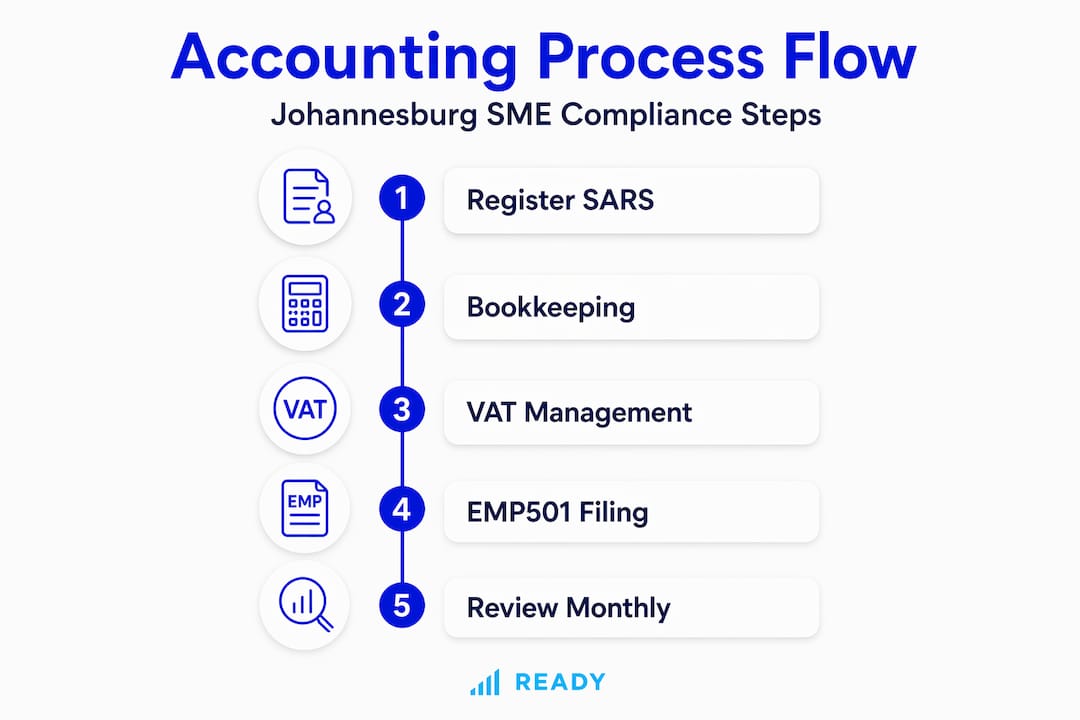
The compliance calendar for a Johannesburg SME is busier than most business owners realise. A capable firm handling your tax services Johannesburg needs to manage several recurring obligations without dropping the ball on any of them.
Here are the non-negotiables your accounting firm should own completely:
-
EMP201 monthly submissions. PAYE, SDL, and UIF payments are due by the 7th of the month following the payroll period, or the last business day if the 7th falls on a weekend or public holiday. SDL sits at 1% of payroll; UIF is 2% split equally between employer and employee.
-
EMP501 annual reconciliation. The 2026 EMP501 filing window runs from 1 April to 31 May. Miss it or submit incomplete data and you face a 1% penalty on your total annual PAYE liability, increasing by 1% each month up to 10%.
-
VAT201 submissions. VAT returns are due by the last business day of the month following the tax period. The VAT rate remains at 15% and the registration threshold stays at R1 million in taxable turnover. If your firm is not tracking this against your invoicing cycle, you are already at risk.
-
Global Minimum Tax (GMT). From 16 March 2026, GMT obligations became administrable via SARS eFiling. This affects a narrower group of taxpayers, but it signals the direction SARS is moving. Your accounting firm needs to be digitally capable enough to handle new eFiling requirements as they emerge.
-
Third-party data submissions. This is where many firms stumble. SARS requires a two-step process: submitting the electronic data file and then submitting the eFiling declaration return with the suffix “-02”. Completing only the first step is a common mistake that creates compliance failures without the business owner ever knowing.
The single biggest cause of EMP501 failures is not a calculation error. It is missing or incorrect Income Tax Reference Numbers on IRP5 certificates. Your accounting firm should be running HR data audits well before the filing window opens, not scrambling to fix errors on the last day of May.
Bookkeeping and financial reporting for Johannesburg SMEs
Tax compliance does not happen in isolation. It sits on top of your bookkeeping, and if your records are messy, your tax submissions will be too. The best accountants in Johannesburg treat bookkeeping and tax as one connected system, not two separate services.
Here is what that looks like in practice:
- Monthly reconciliations that match your bank statements, invoices, and payroll data before any SARS submission is made
- VAT reconciliation that ties your VAT201 figures directly to your accounting records, so there are no surprises during a SARS review
- Annual Financial Statements prepared to CIPC standards, which your company needs for compliance and for any future financing conversations
- Integration between payroll and bookkeeping so that salary journals, PAYE liabilities, and UIF contributions are captured accurately every month
The most common bookkeeping mistakes South African SMEs make include mixing personal and business expenses, failing to reconcile VAT on time, and not keeping supporting documents for every transaction. A firm offering genuine financial consulting Johannesburg businesses can rely on will flag these issues before they become SARS problems.
Cloud accounting tools have changed what is possible here. Real-time data means your accountant can catch a VAT discrepancy in March instead of discovering it during an October audit. If your current provider is still working from spreadsheets emailed back and forth, that is a risk you are carrying unnecessarily.

Pro Tip: Before engaging any accounting firm, ask specifically how they handle VAT reconciliation and whether their bookkeeping process feeds directly into their tax submission workflow. If those two functions are handled separately by different people with no shared system, errors will slip through.
How to choose the right accounting firm in Johannesburg
The market for business accounting experts in Johannesburg is large and uneven. Some firms are genuinely excellent. Others are marketing-heavy and credential-light. Here is a practical framework for making the right call.
| Criteria | What to look for | Red flag |
|---|---|---|
| SARS registration | Active practitioner status on eFiling | Cannot provide registration number |
| RCB membership | SAIPA or SAICA membership | No professional body affiliation |
| Service scope | Tax, payroll, bookkeeping, dispute support | Tax filing only with no bookkeeping |
| Technology | Cloud accounting and eFiling integration | Spreadsheet-based processes |
| Dispute capability | Experience with SARS audits and objections | No mention of tax dispute support |
| 2026 readiness | Familiar with GMT, updated EMP501 window | Unaware of current filing deadlines |
Beyond the table, ask for references from businesses of a similar size and industry. A firm that handles retail VAT well may not have the same depth with construction subcontractor payroll. Context matters.
CPA services in Johannesburg that are worth their fee will also offer proactive compliance management. That means they contact you before a deadline, not after a penalty notice arrives.
Maintaining compliance once your firm is engaged
Hiring a good accounting firm is the start, not the finish. The businesses that stay out of trouble with SARS are the ones that treat compliance as an ongoing internal discipline, not just something they outsource and forget.
Follow these steps to stay on the right side of every deadline:
-
Audit your HR data quarterly. Verify that every employee has a valid Income Tax Reference Number in your payroll system. EMP501 reconciliation success depends on this data being clean before the April filing window opens.
-
Align your internal payment schedule to SARS deadlines. Build the 7th of each month and the last business day of each VAT period into your cash flow planning. Running short on the day a payment is due is avoidable with proper calendar alignment.
-
Confirm your accountant completes both steps of every eFiling submission. The data file and the declaration return are both required. Ask for confirmation of the “-02” declaration after every third-party submission.
-
Schedule a quarterly review with your accounting firm. Use it to check for regulatory changes, review your VAT position, and confirm that your bookkeeping records are audit-ready.
-
Prepare a basic dispute file. Keep copies of all SARS correspondence, submission confirmations, and payment receipts in one place. If SARS ever queries a submission, having this ready cuts response time significantly.
Pro Tip: Set a recurring calendar reminder on the 1st of each month for your EMP201 review. By the time the 7th arrives, your payroll data should already be verified and your payment ready. Leaving it to the last day is how penalties happen.
My take on choosing accounting services in Johannesburg
I have seen too many Johannesburg SMEs make the same expensive mistake. They choose an accounting firm based on a polished website and a low monthly fee, then discover six months later that the firm is not SARS-registered, has never handled an EMP501 reconciliation, and has no idea what to do when a SARS audit letter arrives.
The credibility of any accounting service comes down to SARS and RCB registration, not marketing language. “SARS compliant” is a phrase anyone can put on a website. An Active practitioner status on eFiling is something you can verify in 30 seconds.
What I have also learned is that PAYE reconciliation problems are almost never about wrong calculations. They are about bad data. Missing tax reference numbers, outdated employee records, and payroll systems that nobody has audited in two years. The firms that get this right are the ones who start their HR data clean-up in January, not April.
The 2026 compliance environment is more digital and more demanding than it was three years ago. Accounting firms that are not comfortable with cloud tools, eFiling governance, and payroll best practices are going to cost you more in penalties than they save you in fees. Choose credentials, verify registration, and demand proactive communication. Everything else is secondary.
— Johan
How Readyaccounting helps Johannesburg SMEs stay compliant
Readyaccounting works exclusively with scaling South African SMEs and startups that need more than a once-a-year tax filing service. Every practitioner at Readyaccounting is SARS-registered and RCB-compliant, handling PAYE, VAT, EMP501 reconciliations, and bookkeeping through integrated cloud infrastructure that gives you real-time visibility into your financial position.
Where most accounting firms react to problems, Readyaccounting engineers processes that prevent them. From automating your VAT reconciliation to running pre-season HR data audits, the goal is zero surprises at filing time. If you want to understand how automation can directly improve your cash flow and compliance position, the accounting automation guide is a strong place to start. Ready to work with a firm that treats your finance function as a competitive advantage? Explore outsourced accounting solutions built for Johannesburg SMEs.
FAQ
What makes an accounting firm legally compliant in South Africa?
A legally compliant accounting firm must be registered with a Recognised Controlling Body (RCB) such as SAIPA or SAICA, and hold an Active tax practitioner status on SARS eFiling. You can verify this directly by asking the firm to show their eFiling registration status.
When is the EMP501 submission deadline for 2026?
The 2026 EMP501 employer reconciliation window runs from 1 April to 31 May 2026. Late or incomplete submissions attract a penalty starting at 1% of your annual PAYE liability, increasing monthly up to 10%.
What is the VAT registration threshold for South African SMEs?
The VAT registration threshold remains at R1 million in taxable turnover over any 12-month period. Once you cross this threshold, VAT registration is mandatory and VAT201 returns must be submitted by the last business day of the month following each tax period.
Why do EMP501 submissions fail?
The most common cause of EMP501 failures is missing or incorrect Income Tax Reference Numbers on IRP5 certificates. Running an HR data audit before the April filing window opens is the most effective way to prevent this.
How do I verify a Johannesburg accountant’s credentials?
Ask the accountant for their SARS tax practitioner registration number and their RCB membership details. You can then confirm their Active status through SARS eFiling directly, which takes less than a minute and removes all guesswork.