

What is a balance sheet? A guide for SA business owners
Executive Summary
- A balance sheet shows what a business owns, owes, and the owner’s equity at a specific time. It relies on the equation Assets equals Liabilities plus Equity and is essential for financial analysis. Regularly reading and updating it helps owners monitor cash flow, identify risks, and stay compliant with regulations.
A balance sheet is a financial statement that shows exactly what your business owns, what it owes, and what is left over for you as the owner, all at a single point in time. The formal accounting term is “statement of financial position,” and it rests on one equation: Assets = Liabilities + Equity. Every rand on the left side of that equation must equal every rand on the right. For South African small business owners, understanding balance sheets is not optional. SARS, SAIPA-registered accountants, and any bank considering your loan application will all ask for one.
What is a balance sheet and why does it matter?
A balance sheet gives you a financial snapshot of your business on a specific date, whether that is the last day of your financial year or the end of a quarter. It does not tell you how much profit you made over a period. That is the job of the income statement. The balance sheet tells you where you stand right now.
The accounting equation drives everything: Assets = Liabilities + Equity. If your business owns R500,000 in assets and carries R300,000 in liabilities, your owner’s equity is R200,000. That R200,000 is your net worth in the business. SAICA and SAIPA both require this equation to hold perfectly before any financial statement is considered complete.

For entrepreneurs, the balance sheet answers three questions quickly: Can I pay my bills this month? Do I owe more than I own? Is the business growing in real terms? No other single document answers all three at once.
What are the main components of a balance sheet?
A balance sheet has three sections. Each one feeds directly into the accounting equation.
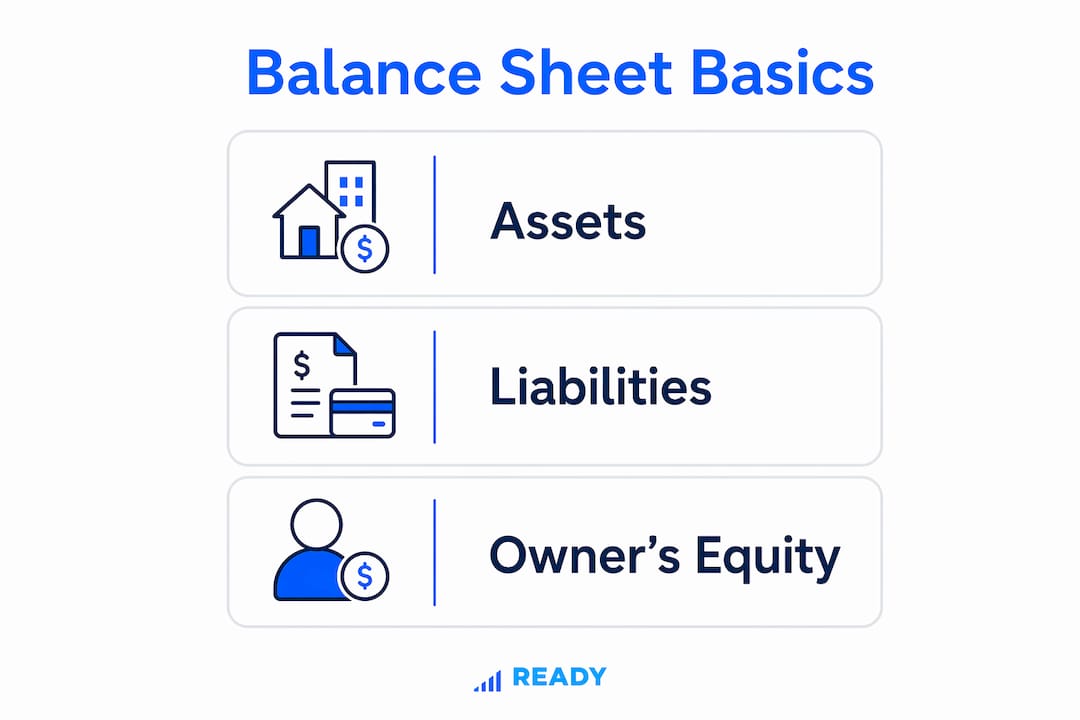
Assets
Assets are everything your business owns or controls that has economic value. They are listed from most liquid to least liquid, meaning cash comes first and property comes last.
- Current assets are converted to cash within 12 months. Examples include cash in your business bank account, trade debtors (customers who owe you money), stock on hand, and prepaid expenses.
- Non-current assets are held for longer than 12 months. Examples include vehicles, machinery, computers, and property. These appear on the balance sheet at cost less accumulated depreciation.
Liabilities
Liabilities are everything your business owes to others. Like assets, they are split by time horizon.
- Current liabilities are due within 12 months. Common examples for South African SMEs include trade creditors, short-term bank overdrafts, wages payable, and VAT owing to SARS. If your business is VAT registered, the VAT output tax you have collected but not yet paid sits here as a current liability.
- Non-current liabilities are obligations due after 12 months. Business loans, hire purchase agreements on equipment, and long-term lease obligations all belong in this category.
Owner’s equity
Owner’s equity is the residual interest in the business after all liabilities are subtracted from all assets. It includes the owner’s original capital contributions and retained earnings accumulated over time. Retained earnings and contributions together reflect the net worth built up inside the business. Negative equity means the business owes more than it owns, which is a serious warning sign.
Pro Tip: Always separate your personal finances from your business finances before preparing a balance sheet. Mixing the two is the single most common error Readyaccounting sees in first-time SME submissions.
How do you prepare a balance sheet step by step?
Preparing a balance sheet follows a clear process. Skipping any step produces a document that balances mathematically but misleads you financially.
- Choose your reporting date. Pick the last day of your financial year, quarter, or month. SARS and most lenders expect year-end figures, but monthly or quarterly reports give you far more useful trend data.
- List all assets by liquidity. Start with cash, then debtors, then stock, then fixed assets. Assign a rand value to each line item based on your accounting records.
- List all liabilities by maturity. Current liabilities first, then non-current. Include your VAT liability to SARS, any PAYE owing, and all outstanding loan balances.
- Calculate owner’s equity. Add the opening equity balance to any new capital contributions, then add net profit for the period (or subtract a net loss). Retained earnings from prior years carry forward automatically.
- Verify the equation. Total assets must equal total liabilities plus total equity. If they do not, you have a classification error or a missing entry somewhere.
Typical reporting intervals for South African SMEs are monthly, quarterly, and annually. Monthly balance sheets are the most useful for cash flow planning. Annual balance sheets satisfy SARS and CIPC filing requirements.
Pro Tip: Do not wait until year-end to prepare your first balance sheet. A quarterly balance sheet prepared in month three catches classification errors early, before they compound into a SARS audit trigger.
A good bookkeeping guide walks you through the chart of accounts structure that feeds directly into each balance sheet line. Getting that foundation right makes every subsequent balance sheet faster and more accurate.
How to read a balance sheet to assess financial health
Reading a balance sheet means going beyond checking that it balances. The real value comes from the ratios and relationships between the numbers.
Working capital
Working capital is current assets minus current liabilities. Positive working capital means your business can cover its short-term obligations. Negative working capital means you cannot, and that is an immediate cash flow problem. A business with R200,000 in current assets and R350,000 in current liabilities is technically insolvent in the short term, regardless of how profitable it looks on the income statement.
Equity position
Positive equity signals that the business has built net worth over time. Negative equity means liabilities exceed assets and requires immediate corrective action. Lenders and investors treat negative equity as a disqualifying factor for most financing applications.
Red flags to watch for
- Assets that are overvalued because stock has not been written down for obsolescence
- Loans from directors classified as equity rather than liabilities
- VAT owing to SARS sitting in the wrong category
- Missing accruals for expenses incurred but not yet invoiced
A balance sheet that balances is not the same as a balance sheet that is accurate. Auditing classifications, not just totals, is what separates a useful financial document from a dangerous one.
The balance sheet alone does not reveal performance over time. Combined review with the income statement and cash flow statement gives you the complete picture. Think of the balance sheet as a photograph and the income statement as the video. You need both to understand what is really happening.
Pro Tip: Check your balance sheet against your cash flow statement every month. If your profit is growing but cash is shrinking, the balance sheet will show you exactly where the money is stuck, usually in debtors or stock.
Common mistakes that distort your balance sheet
A mathematically balanced sheet can still be completely wrong. This is the most dangerous misconception small business owners carry into financial reporting.
Misclassifying liabilities and assets is the most common error. A five-year business loan classified as a current liability makes your working capital look worse than it is. Stock valued at cost when it is worth far less inflates your assets artificially. Both errors produce a sheet that balances but misleads.
Common mistakes that distort balance sheets:
- Classifying long-term loans as current liabilities (or vice versa)
- Failing to depreciate fixed assets, which overstates asset values
- Omitting accrued expenses, which understates liabilities
- Treating owner drawings as business expenses rather than equity reductions
- Ignoring contingent liabilities in footnotes, such as pending legal claims or SARS disputes
Footnotes matter more than most owners realize. Investors and lenders scrutinize footnotes to find risks that do not appear in the main numbers. A pending SARS audit, a personal guarantee on a business loan, or a disputed debtor balance all belong in the footnotes.
Consistent reporting intervals are equally critical. A balance sheet prepared in march compared to one prepared in september tells you nothing useful if your business is seasonal. Standardize your dates and your comparisons become meaningful.
Pro Tip: Treat your balance sheet as a diagnostic tool, not a compliance checkbox. Run it monthly, compare it to the prior period, and ask one question: what changed and why?
Key takeaways
A balance sheet is the single most direct measure of your business’s financial position, and reading it correctly separates owners who react to problems from those who prevent them.
| Point | Details |
|---|---|
| Core equation | Assets = Liabilities + Equity must hold exactly; any gap signals a classification or data error. |
| Working capital matters | Current assets minus current liabilities reveals whether you can meet short-term obligations. |
| Balanced does not mean accurate | Misclassified entries produce a sheet that balances but hides real financial risk. |
| Footnotes carry hidden risk | Contingent liabilities like SARS disputes or legal claims appear in footnotes, not main totals. |
| Consistent intervals are required | Monthly or quarterly balance sheets enable trend analysis; sporadic reporting misleads. |
Why I think most small business owners are reading their balance sheets wrong
Most entrepreneurs I work with treat the balance sheet as a year-end obligation. They hand it to their accountant in february, sign off on it in april, and file it away. That approach wastes the most useful financial document in your business.
The balance sheet is the only statement that tells you the cumulative result of every financial decision you have ever made in the business. The income statement resets every year. The balance sheet carries everything forward. That means every misclassification, every unrecorded liability, and every overvalued asset compounds silently until it surfaces as a SARS query or a bank rejection.
What I have found actually works is treating the balance sheet as a monthly diagnostic. You do not need a full audit every month. You need to check three numbers: working capital, total equity, and the ratio of current to non-current liabilities. Those three figures tell you whether the business is getting stronger or weaker, regardless of what the income statement says.
The owners who grow fastest are not the ones with the highest revenue. They are the ones who read their balance sheets and act on what they see. Understanding your financial position is not an accounting exercise. It is a competitive advantage.
— Johan
How Readyaccounting helps you build accurate balance sheets
Accurate balance sheets do not come from manual spreadsheets updated once a year. They come from clean, automated data flowing in real time. Readyaccounting replaces manual bookkeeping with cloud accounting infrastructure that keeps your assets, liabilities, and equity figures current every single day. Our accounting automation approach eliminates the classification errors and missing accruals that make balance sheets unreliable. Whether you need monthly management accounts, SARS-compliant annual financial statements, or a Fractional CFO to interpret what the numbers mean, Readyaccounting gives South African SMEs the financial visibility to make faster, better decisions. Contact us to get your balance sheet working for you, not just filed away.
FAQ
What is the balance sheet definition in simple terms?
A balance sheet is a financial statement showing what a business owns (assets), what it owes (liabilities), and the owner’s remaining interest (equity) on a specific date. The three sections always satisfy the equation: Assets = Liabilities + Equity.
What are the main balance sheet components?
The three components are assets (current and non-current), liabilities (current and non-current), and owner’s equity (capital contributions plus retained earnings). Each component must be classified correctly for the statement to be meaningful.
How do you read a balance sheet to check financial health?
Calculate working capital by subtracting current liabilities from current assets. Positive working capital means the business can meet short-term obligations. Negative equity signals that liabilities exceed assets and requires immediate attention.
How often should a small business prepare a balance sheet?
Monthly or quarterly balance sheets provide the most useful trend data for South African SMEs. Annual balance sheets satisfy SARS and CIPC requirements, but monthly preparation catches errors and cash flow problems far earlier.
What is the difference between a balance sheet and an income statement?
A balance sheet shows financial position at a single point in time. An income statement shows revenue, expenses, and profit over a period. You need both, along with the cash flow statement, for a complete picture of your business’s financial health.
Recommended
- Balance sheets explained: A South African SME owner’s guide | Ready Accounting
- Income statement guide for South African SMEs | Ready Accounting
- Execution Framework: Read a Balance Sheet for SA Business Owners 2025 | Ready Accounting
- What does a bookkeeper do? Essential guide for SA businesses | Ready Accounting