

When to hire a CFO: the strategic move for SA SMEs
Executive Summary
- Most South African SMEs carry financial strategy alone until growth stalls or cash shortages occur, making CFO support essential.
- A fractional CFO offers strategic financial guidance, risk management, and forecasting expertise at a lower cost than a full-time executive.
Most South African founders spend years carrying the full weight of financial strategy alone, and the cracks only show when growth stalls, cash runs short, or a funding round falls apart. Hiring a CFO is not a reward for success; it is often the catalyst for it. This guide maps out exactly when and why a growing SME should consider bringing in CFO-level support, whether full-time or fractional, and what that decision could mean for the trajectory of your business. If you have been wondering whether it is time to get strategic help, the answer is probably yes.
Table of Contents
- The evolving role of a CFO for SMEs
- Key signals it’s time to hire a CFO
- SME advantages: what a fractional CFO unlocks
- How to get started: finding and integrating a fractional CFO
- Why waiting too long could cost your business more
- Scale smarter: how Ready Accounting supports your CFO journey
- Frequently asked questions
Key Takeaways
| Point | Details |
|---|---|
| Watch for key triggers | Rapid growth, cash flow strain, and founder burnout all signal it’s time to consider a CFO. |
| Fractional CFO fits SMEs | Part-time financial leadership delivers strategic benefits without permanent overhead. |
| Business impact is measurable | 85 percent of SMEs with CFO support report stronger planning and forecasting. |
| Start early to avoid risk | Delaying CFO involvement can mean missed opportunities and higher costs down the line. |
The evolving role of a CFO for SMEs
The traditional CFO image is someone buried in spreadsheets, managing compliance, and producing end-of-year reports. That picture is outdated, especially for SMEs operating in South Africa’s fast-moving economic environment. Today’s CFO is part strategist, part risk manager, part fundraising partner, and part operational leader.
For most small and medium businesses, the obstacle has always been cost. A full-time CFO in South Africa can cost upward of R1.5 million per year in total compensation. That figure puts permanent executive finance talent out of reach for most businesses turning over under R50 million. This is exactly where the fractional CFO model steps in.
A fractional CFO is a senior finance professional who works with your business on a part-time or project basis. They bring the same executive thinking and financial experience as a permanent CFO, without the full-time price tag. Fractional CFO demand rises in South Africa because SMEs increasingly need strategic financial guidance without taking on permanent overhead.
Here is what a CFO, fractional or otherwise, actually does for your business:
- Builds and maintains financial forecasts and cash flow models
- Leads scenario planning and stress-testing for growth decisions
- Manages risk exposure, including currency, credit, and operational risks
- Prepares the business for investor due diligence or bank funding applications
- Ensures compliance with SARS, CIPC, and other regulatory requirements
- Acts as a strategic partner to the CEO and board
“The fractional model brings objectivity, broader networks, and material cost savings compared to full-time hires, while dramatically improving a business’s ability to forecast, plan, and reduce financial risk.”
You can read more about what this looks like in practice by exploring outsourced CFO services for South African SMEs. The flexibility of fractional arrangements also means you can scale the engagement up or down as your business needs change, which is a significant advantage during growth spurts or restructuring phases.
Key signals it’s time to hire a CFO
Understanding what a CFO does is one thing. Knowing when your business actually needs one is another. Many founders delay this decision because they assume CFO-level support is only relevant once they reach enterprise scale. That assumption is expensive.
Fast growth triggers gaps in financial controls, forecasting, and decision-making that a bookkeeper or accountant alone cannot close. When you are scaling, the volume and complexity of financial decisions increases exponentially while the cost of getting them wrong also multiplies.
Common triggers that signal your business needs CFO-level support:
- Annual revenue approaching or exceeding R20 million, where financial complexity increases sharply
- Preparing for external funding, whether from a bank, private equity, or venture capital
- Recurring cash flow shortfalls that cannot be explained or resolved with basic bookkeeping
- Strategic pivots, such as entering new markets, launching new products, or acquiring another business
- Leadership bandwidth constraints, where the founder is spending more than 20% of their time managing finances instead of the business
- Investors or board members requesting detailed financial reporting you currently cannot produce
Here is a simple comparison of what each finance support model delivers:
| Attribute | DIY finance | Accountant only | Fractional CFO |
|---|---|---|---|
| Compliance and tax | Partial | Strong | Strong |
| Cash flow forecasting | Weak | Limited | Strong |
| Strategic planning | None | None | Core function |
| Funding preparation | None | Limited | Strong |
| Risk management | None | Limited | Core function |
| Cost | Low | Medium | Medium |
| Scalability | None | Low | High |
The contrast is stark. An accountant is essential, but their role is fundamentally historical. They tell you what happened. A CFO tells you what is about to happen and helps you shape that outcome. A practical financial forecasting guide can show you how forward-looking finance changes the quality of your decisions. The outsourcing accounting benefits for South African SMEs extend well beyond cost savings when CFO-level strategy is included.
Pro Tip: You do not need to commit to a full engagement immediately. Even a few hours of fractional CFO input per month can de-risk scaling decisions that might otherwise cost you significantly more to undo.
SME advantages: what a fractional CFO unlocks
Knowing the warning signs matters. But the more motivating question is what a fractional CFO actually creates for your business once they are involved. The data from the South African SME landscape is compelling.
85% of SMEs with CFO support reported improved capacity to plan and forecast business performance, whether that support was full-time or fractional. That is not a marginal improvement. Better forecasting directly affects how confidently you hire, invest, price, and plan. It is the foundation of sustainable growth rather than lucky growth.
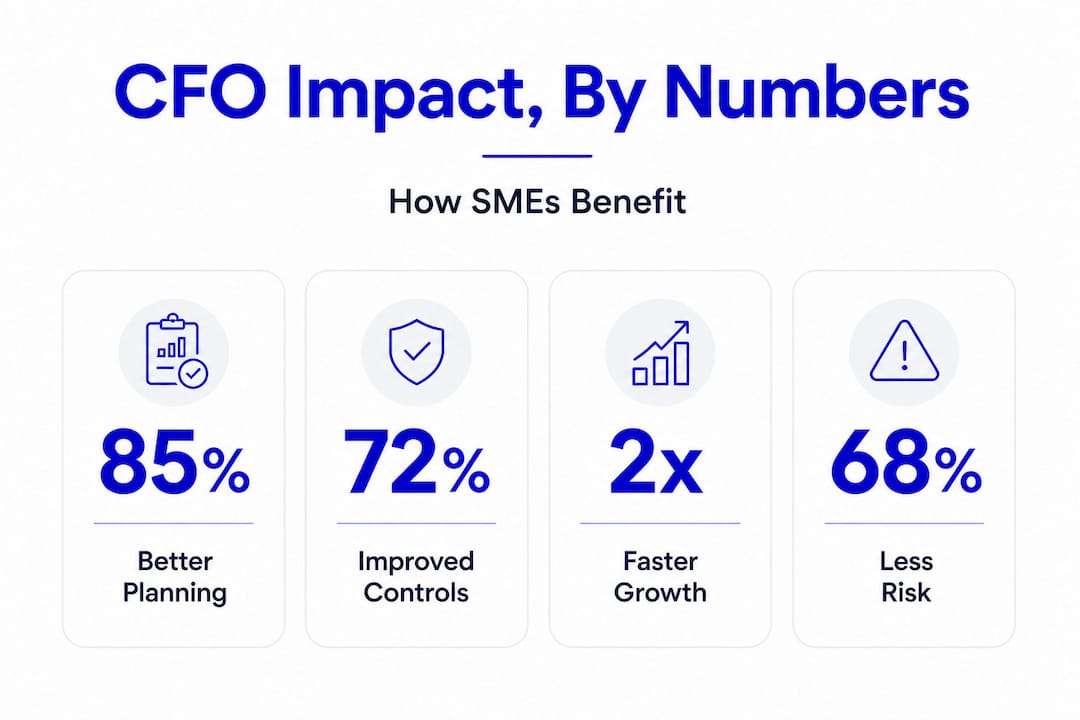
The strategic timing for engaging a fractional CFO in South African SMEs points to key inflection points: when revenue crosses R20 million, when a funding event is on the horizon, or when cash flow risk becomes a real operational threat. At these moments, the cost of not having CFO-level guidance outweighs the cost of bringing one in.
Here are the four primary advantages that fractional CFO involvement unlocks for scaling SMEs:
-
Smarter forecasting and scenario planning. A fractional CFO builds models that account for multiple growth scenarios, helping you understand what your cash position looks like under optimistic, realistic, and conservative assumptions. This removes the guesswork from growth decisions and surfaces problems before they become crises. Why forecasting matters for South African SMEs cannot be overstated.
-
Risk identification and mitigation. From overtrading (growing faster than your cash can support) to foreign exchange exposure on import-heavy operations, a CFO spots risks that founders often miss because they are too close to the day-to-day. Early identification of risk translates directly into avoided losses.
-
Funding readiness and investor relations. Whether you are approaching a bank for a growth facility or presenting to investors, your financial storytelling needs to be tight. A fractional CFO prepares the models, stress tests the assumptions, and coaches you on how to present your numbers confidently. Many SMEs lose funding opportunities not because their business is weak, but because their financial pack is unconvincing.
-
Scalable financial structure. As your business grows, your finance function needs to grow with it. A CFO designs the systems, controls, and reporting infrastructure that supports scale, preventing the chaos that often hits businesses between R15 million and R50 million in revenue.
| Business outcome | Without CFO support | With fractional CFO |
|---|---|---|
| Cash flow visibility | Reactive, monthly | Proactive, rolling 13-week |
| Financial reporting quality | Basic and historical | Forward-looking and strategic |
| Funding success rate | Low to medium | High |
| Risk detection | Post-event | Pre-event |
| Founder time on finance | High (15 to 30%) | Low (under 5%) |
| Business scalability | Limited | Structured and supported |
The shift from reactive to proactive finance is the single most important change a fractional CFO drives in an SME. When you stop reacting to your numbers and start shaping them, everything changes.
How to get started: finding and integrating a fractional CFO
Once you recognise the need, the next step is taking action. Many founders stall here because the process feels unfamiliar. It does not have to be complicated.
Finding a qualified fractional CFO in South Africa is more straightforward than it used to be, given the growing demand for fractional expertise across the SME sector. Here is a practical approach:
-
Define your specific needs before searching. Are you preparing for a funding round? Managing a cash flow crisis? Building financial infrastructure for scale? Your answer shapes the profile you need. A CFO who excels in investor relations is different from one who specialises in operational finance.
-
Seek referrals from your existing network. Accountants, attorneys, and fellow founders are often your best source of warm introductions to fractional CFOs with proven track records in your industry.
-
Clarify scope, time commitment, and outcomes upfront. A fractional engagement works best when both parties agree on deliverables rather than hours. What will better cash flow visibility look like at 90 days? What financial model will be built and by when?
-
Integrate the CFO with your existing team. Your bookkeeper and accountant should not feel threatened by a fractional CFO; they should be empowered by one. Define communication flows, reporting lines, and tool access before the engagement starts to avoid duplication or confusion.
-
Measure the engagement against agreed outcomes. Fractional arrangements should be held to clear performance markers. If forecasting accuracy improves, funding conversations advance, or founder time on finance drops, the engagement is working.
You can also explore how outsourced accounting services complement fractional CFO support by handling the day-to-day finance function, allowing the CFO to focus purely on strategy and leadership.
Pro Tip: Start with a 60-day pilot project focused on a single outcome, such as building a 13-week cash flow forecast or preparing your funding model. This tests fit, builds trust, and delivers immediate value before you commit to a longer engagement.
Why waiting too long could cost your business more
Here is a perspective most CFO hiring guides avoid. The financial cost of waiting is real, but it is not always visible on your income statement. It shows up in the quality of decisions made without proper financial insight, in the opportunities missed because your numbers were not investor-ready, and in the quiet erosion of a founder’s energy as finance tasks crowd out strategic thinking.
Many South African SMEs operate with the belief that a CFO is something you earn the right to hire after hitting a certain milestone. The logic seems sensible: grow first, then professionalise. But this gets the sequence backwards. Professionalising your finance function is what enables the growth you are chasing. Budgeting for growth in South African SMEs is not just administrative discipline; it is the scaffolding on which scale is built.
The founder who waits spends years making capital allocation decisions, hiring choices, and pricing calls without a proper financial model. Each of those decisions carries a margin of error that compounds over time. A single poorly timed overdraft, a pricing structure that quietly destroys margin at scale, or a funding raise that collapses at due diligence because the numbers are inconsistent, any one of these events can set a business back by years.
Early CFO involvement does not just prevent problems. It creates an entirely different strategic posture. Businesses with financial leadership embedded from the growth phase build sharper competitive positioning, stronger investor relationships, and more resilient operating models. The CFO becomes the person who asks the questions your enthusiasm might skip, and that friction is precisely what prevents expensive mistakes.
Scale smarter: how Ready Accounting supports your CFO journey
If you are at the point where financial leadership feels overdue, Ready Accounting was built for exactly this stage of your business. We act as your fractional CFO, combining cloud accounting benefits with real-time financial intelligence so you always know where your business stands. Our approach replaces manual, reactive finance with automated systems and executive-level strategy, giving you the insight to make confident decisions. Whether you are still figuring out when to hire a bookkeeper or ready to step into full fractional CFO support, we can meet you where you are. Explore what working with Ready Accounting as your outsourced accounting firm actually looks like for a scaling South African SME.
Frequently asked questions
What is a fractional CFO and how is it different from a full-time CFO?
A fractional CFO provides executive financial leadership on a part-time or contract basis, giving your business high-level expertise without the full cost of a permanent hire. Demand for this model is rising across South Africa as SMEs seek strategic guidance without permanent overhead.
When should a South African SME consider hiring a CFO?
You should consider a CFO when scaling quickly, raising capital, facing cash flow issues, or when financial management demands exceed in-house capabilities. Fast growth, cash flow strain, and founder overload are the clearest signals.
What measurable benefits do SMEs see from hiring CFO support?
SMEs with CFO input see improved forecasting, better financial controls, and reduced risk. 85% report stronger planning and performance when CFO support is in place.
Can I start with part-time CFO services before committing full-time?
Yes, many South African SMEs use fractional CFO input to bridge the gap until a full-time executive is needed. Fractional arrangements offer flexibility and cost advantages that make them ideal for businesses in transition.
How much does a fractional CFO typically cost in South Africa?
Fractional CFO fees vary based on scope and hours, but they are generally a fraction of the R1.5 million or more that a full-time CFO costs annually, making them accessible for businesses generating R10 million to R50 million in revenue.
Recommended
- Outsourced CFO services for South African SMEs: grow faster | Ready Accounting
- Financial forecasting: a practical guide for SA SMEs | Ready Accounting
- Why budgeting matters for South African SME growth | Ready Accounting
- Financial forecasting: why it matters for SA Scaling Companies | Ready Accounting