

Boost financial integrity with ethical accounting practices
Executive Summary
- Ethical accounting involves integrity, transparency, and compliance beyond legal minimums.
- Meeting SARS obligations is essential to avoid penalties and support long-term growth.
- Embedding ethical practices daily builds trust, resilience, and a competitive advantage for SMEs.
South African SMEs face a stark reality: the South African Revenue Service (SARS) recovered R8.3 billion from SME audits in a single financial year alone. That figure should stop any business owner cold. Ethical accounting is not a luxury reserved for large corporations with dedicated compliance teams. It is the bedrock of sustainable growth, stakeholder trust, and long-term survival for every small and medium business operating in South Africa today. This guide unpacks what ethical accounting genuinely means, what SARS requires as a non-negotiable baseline, where SMEs most commonly slip up, and how to build a culture of financial integrity into your daily operations.
Table of Contents
- What does ethical accounting mean for South African SMEs?
- Key SARS compliance requirements: The ethical baseline
- Common ethical dilemmas and audit risks in South Africa
- How to embed ethical accounting in daily operations
- Why prioritizing ethics can future-proof your South African SME
- Take the next step: Tools and support for ethical accounting
- Frequently asked questions
Key Takeaways
| Point | Details |
|---|---|
| Go beyond compliance | Ethical accounting is about integrity and trust, not just meeting legal requirements. |
| Proactive registration matters | Registering and maintaining complete records from day one reduces audit and penalty risks. |
| Avoid creative accounting | Short-term shortcuts increase audit risk and damage reputation. |
| Leadership sets the tone | Embedding ethics in company culture and systems is essential for SME resilience. |
| Ethics attract partners | Ethical SMEs gain trust, bounce back from crises, and win investment. |
What does ethical accounting mean for South African SMEs?
Ethical accounting goes far beyond filing your returns on time and keeping receipts in a folder. At its core, it means operating with consistent integrity, presenting your finances transparently, recording transactions accurately, and treating compliance not as a burden but as a signal of your business character.
Ethical accounting for South African SMEs emphasizes integrity, transparency, accurate record-keeping, and compliance with SARS regulations beyond mere legal requirements. This distinction matters enormously. The legal minimum is just that, a minimum. Ethical accounting asks what a reasonable, responsible business owner would do even when no one is watching.
A common misconception is that ethics and compliance are the same thing. They are not. Compliance is reactive. You follow the rules because you have to. Ethics is proactive. You do the right thing because it protects your business, your employees, and your clients. Research on perspectives on business ethics in South African small businesses reveals a troubling pattern: many owners believe that complete ethical compliance is either impossible or commercially disadvantageous in the local environment. That belief is understandable given the pressures SMEs face, but it is demonstrably wrong and expensive.
“Ethics is not a constraint on business success. In the South African SME context, it is one of the most underused competitive advantages available.”
The reality is that businesses which treat ethical accounting as a strategic asset, not just a legal checkbox, attract better partners, retain clients longer, and recover faster from economic shocks. They also sleep better at night.
The five pillars of ethical accounting for South African SMEs are:
- Integrity: Every transaction is recorded honestly, regardless of who is reviewing it.
- Transparency: Financial statements reflect the true state of the business without creative manipulation.
- Accountability: Someone in the business is always clearly responsible for financial oversight.
- Legal adherence: All SARS obligations, company law requirements, and sector-specific regulations are met in full.
- Stakeholder trust: Investors, lenders, suppliers, and employees can rely on your numbers.
Understanding your director responsibilities under South African law is essential to building this foundation. Directors carry personal accountability for financial misstatements, which makes ethical accounting a matter of personal legal protection as much as business strategy. Familiarity with core accounting principles will help you understand what accurate reporting actually looks like in practice. Additionally, integrating corporate social responsibility into your financial culture can strengthen your reputation with the community and potential investors.
Key SARS compliance requirements: The ethical baseline
With the concept of ethics clear, let us break down the non-negotiable rules every SME must follow. Meeting your statutory obligations is the floor of ethical accounting, not the ceiling. Ignoring these requirements is not a grey area. It is a direct path to penalties, interest charges, and in serious cases, criminal prosecution.
According to the SARS Tax Guide for Small Businesses, SMEs must register for taxes upon starting a business. VAT registration is compulsory once your taxable turnover exceeds R1 million per year, and voluntary registration is possible from R50,000. Provisional tax applies to any business earning income not subject to PAYE deductions, and PAYE registration is required the moment you take on your first employee.
Here is a step-by-step overview of the registration and reporting process every SME should follow:
- Register your business with SARS for income tax immediately upon commencing operations.
- Assess your VAT position monthly and register compulsorily when turnover crosses R1 million, or voluntarily if it benefits your cash flow above R50,000.
- Submit provisional tax returns twice a year (and a third optional payment) to avoid underestimation penalties.
- Register for PAYE, UIF, and SDL before your first payroll run if you have employees.
- Keep detailed records of all transactions for at least five years as SARS requires.
- Submit accurate returns on time for every applicable tax type, every period, without exception.
| Obligation | Compulsory threshold | Voluntary option |
|---|---|---|
| VAT registration | R1 million annual turnover | From R50,000 turnover |
| Provisional tax | Any non-PAYE income | Not applicable |
| PAYE | First employee hired | Not applicable |
| Income tax | All registered entities | Not applicable |
| UIF contributions | Any permanent employee | Not applicable |
This table illustrates a crucial point: VAT is the one area where SMEs have some choice, but that choice disappears once you cross the R1 million threshold. Many growing businesses are caught off guard when they hit that mark mid-year without having planned for VAT administration. That surprise creates cash flow crises, late registration penalties, and sometimes retrospective liability.
Pro Tip: Register for VAT voluntarily well before you hit the R1 million threshold if your clients are VAT-registered businesses. You will be able to claim input VAT on your expenses immediately, improving your net cash position while demonstrating proactive compliance to SARS.
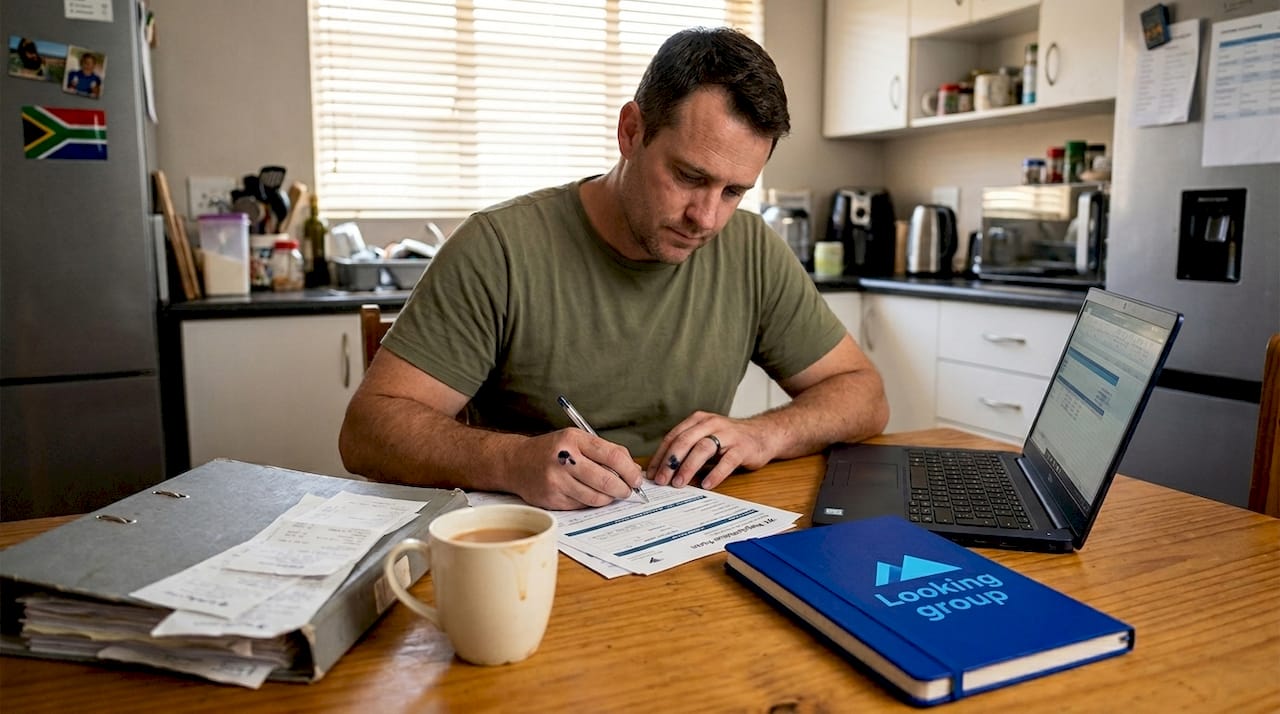
Our detailed tax compliance protocol walks through each of these requirements in depth, with practical timelines and checklists designed specifically for South African SMEs navigating growth.
Common ethical dilemmas and audit risks in South Africa
Once you know the basics, it is crucial to understand the grey areas and what happens when ethics slip. The pressure on South African SMEs is real. Cash flow is tight, competition is fierce, and the temptation to shade the numbers, just a little, is something many owners face at some point. Understanding where these temptations lead is the best defence against them.
The most common ethical risks in South African SMEs include:
- Underreporting revenue: Accepting cash payments and not recording them fully, particularly common in retail, hospitality, and professional services.
- Inflating expenses: Claiming personal expenditure as business costs to reduce taxable income.
- Creative accounting: Using technically legal but misleading accounting treatments to distort profitability, a practice that erodes integrity over time even when it feels pragmatic in the moment.
- Cash flow manipulation: Timing the recognition of income or expenses to artificially shift tax liability between periods without genuine business justification.
- Related-party transactions: Paying personal service providers or family members at inflated rates to extract business funds without tax.
The stakes are severe. SARS audit data shows that 11,000 SME audits in 2017/18 alone yielded R8.3 billion in additional tax recovered. That is not a rounding error. That is an institution with sophisticated data matching tools, lifestyle audit capability, and the legal power to access your bank accounts, supplier invoices, and employee salary records simultaneously.
Lifestyle audits are particularly powerful and underestimated by many SMEs. SARS compares the lifestyle indicators of business owners, such as property ownership, vehicle registrations, overseas travel, and school fees paid, against declared income. If the numbers do not add up, that discrepancy triggers a full audit. You cannot drive a luxury vehicle on a declared income that would not cover its monthly instalment.
| Factor | Ethical practice | Unethical practice |
|---|---|---|
| SARS audit risk | Low, predictable | High, unpredictable, costly |
| Access to funding | Strong, bankable financials | Weak, inconsistent records |
| Business reputation | Investor and supplier trust | Damaged credibility |
| Legal exposure | Minimal | Criminal liability possible |
| Long-term survival | High resilience | Fragile, crisis-dependent |
Reviewing financial statement examples for South African SMEs can help you benchmark what clean, audit-ready records actually look like versus the manipulated financials that attract scrutiny.
How to embed ethical accounting in daily operations
Understanding the risks leads us to strategies you can apply daily to build an ethical culture from the inside out. This is where theory becomes practice, and where most SMEs either succeed or stall.
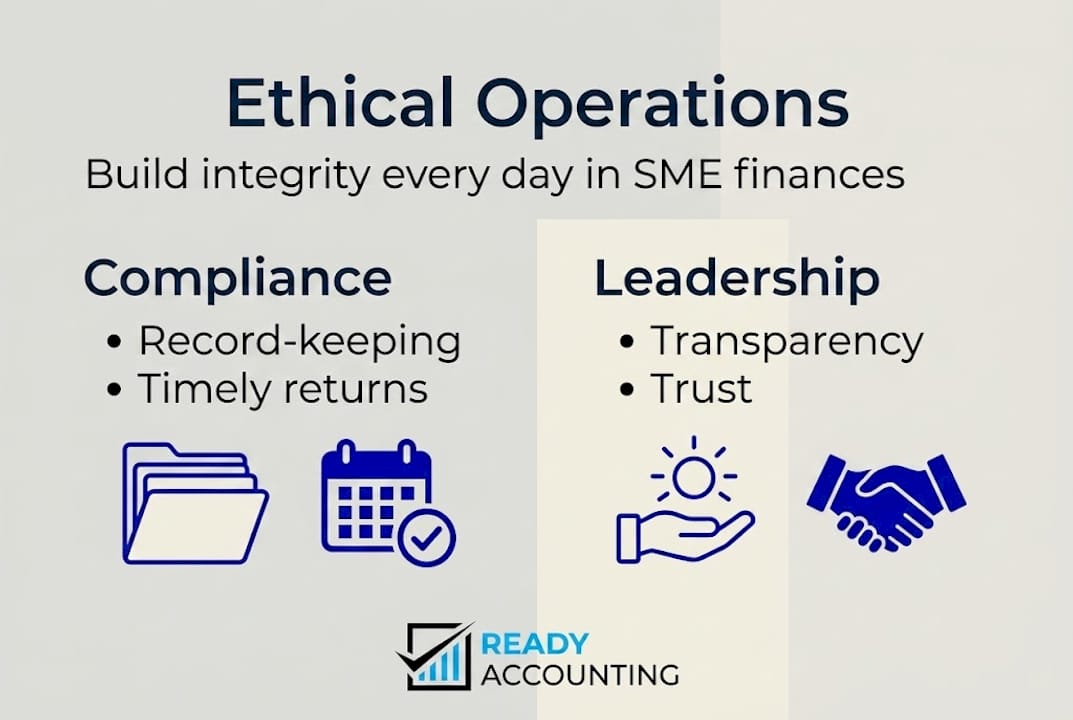
Ethical accounting is not a once-a-year audit preparation exercise. It is a daily habit, a company culture, and a leadership commitment. Here is how to build it concretely:
- Write a code of conduct that specifically addresses financial behaviour. Commit to it, sign it, and make every employee and contractor acknowledge it. Vague promises do not change behaviour. Written, witnessed policies do.
- Segregate financial duties so that no single person can both authorise a payment and record it in the books. This is the most powerful fraud deterrent available to any SME without a large finance team.
- Conduct monthly internal reviews of your trial balance, bank reconciliation, and accounts payable/receivable. Do not wait for your accountant’s annual visit to spot problems.
- Train your staff on basic financial ethics, especially anyone who handles cash, invoices, or supplier payments. You cannot enforce a standard your team does not understand.
- Implement cloud-based accounting software with full audit trails, so every transaction is timestamped, user-stamped, and permanently accessible for review.
Pro Tip: The ICAEW 2026 ethics update confirms that tax planning is acceptable only when there is a credible legal basis for every position taken. If your accountant cannot clearly explain the legal grounding for a tax strategy, treat that as a red flag, not an opportunity.
Simple daily controls that make a measurable difference include:
- Dual sign-off on all payments above a set threshold, such as R5,000, to prevent unauthorized outflows.
- Automated bank feeds that reduce manual data entry and the manipulation that comes with it.
- Regular supplier statement reconciliations to ensure every liability is accurately recorded.
- Expense policy enforcement with receipts required for every single claim, regardless of amount.
- Monthly profit and loss reviews with the business owner present, not just the bookkeeper.
King IV, the South African corporate governance code, promotes ethical leadership as a cornerstone of good governance. While King IV is technically voluntary for SMEs, its principles are practical and proven. Adopting them signals to investors, lenders, and strategic partners that your business operates to a higher standard than the market minimum. That signal has tangible financial value.
When you are setting SME financial goals, build ethical compliance metrics directly into your targets, not as a separate administrative task but as a core performance indicator alongside revenue and gross margin.
Why prioritizing ethics can future-proof your South African SME
Here is the argument most guides miss entirely: ethical accounting is not just about avoiding trouble. It is about building an asset that compounds over time.
The conventional narrative positions ethical accounting as a cost, time spent, money invested in good software, effort applied to training staff. That framing is wrong. The real question is what the absence of ethical accounting costs you. It costs you access to growth capital because banks and investors cannot trust manipulated financials. It costs you key clients who require clean supplier records as part of their own compliance. It costs you your own peace of mind every time SARS sends a letter.
Ethical business practices enhance trust, attract investment, and build resilience that outlasts short-term tax minimization strategies. The SMEs that survived the economic disruptions of recent years were disproportionately those with accurate records, transparent reporting, and strong stakeholder relationships. Chaos favours the prepared.
“Audit readiness is not a defensive posture. It is a competitive advantage that lets you move faster than rivals who are hiding from scrutiny.”
We have seen businesses lose funding rounds because their management accounts could not reconcile to their annual financial statements. We have seen owners face personal liability because they treated the business bank account as a personal ATM. The short-term savings from creative accounting are almost always smaller than the long-term cost of unwinding them. Your reputation as a financially trustworthy business is genuinely difficult to build and brutally easy to destroy. Protect it by making ethics the default, not the exception. Explore scaling SME strategies built on the kind of financial foundation that actually supports growth rather than undermining it.
Take the next step: Tools and support for ethical accounting
Ready Accounting builds the financial infrastructure that makes ethical accounting the path of least resistance for scaling South African SMEs. From automated cloud bookkeeping that creates tamper-proof audit trails, to real-time dashboards that keep you informed before SARS ever comes knocking, we engineer the systems that turn compliance from a burden into a business asset. If you want to reduce tax liability through legitimate, defensible strategies rather than risky shortcuts, or need a clear plan to avoid tax penalties before they become a crisis, our resources and fractional CFO services are built specifically for businesses at your stage of growth.
Frequently asked questions
What is the difference between ethical accounting and legal compliance?
Ethical accounting means acting with integrity and transparency, not just following minimum legal requirements, to build long-term trust with SARS, investors, and stakeholders. Legal compliance is the floor, while ethical accounting is the standard you hold yourself to even above that floor.
Why should my SME care about ethical accounting if tax minimization is legal?
Aggressive tax avoidance, even when technically legal, can trigger audits, damage trust, and weaken relationships with lenders and clients. Ethical practices build the resilience and credibility that legal minimization strategies alone cannot provide.
What are common audit risks for South African SMEs with poor records?
Poor record-keeping leaves your business exposed to SARS audit triggers, lifestyle audits, and penalties if underreporting is detected, all of which are far more costly than the compliance investment they replace.
Which global ethical frameworks or updates apply to South African SMEs?
The King IV Code promotes ethical leadership across South African businesses, and the ICAEW 2026 ethics update confirms that tax planning requires a credible legal basis, making both frameworks highly relevant even though King IV remains voluntary for SMEs.
Recommended
- Execution Framework: Improve Financial Reporting for Better Decision-Making | Ready Accounting
- Accounting Aggressive Optimization Standards for SA Businesses in 2025 | Ready Accounting
- Basic Accounting Principles for South African Businesses 2025 | Ready Accounting
- Aggressive Optimization Standards in Financial Management for South African Businesses | Ready Accounting